Comparative Negligence in Motorcycle Accidents
It's an unfortunate truth that even when you're doing everything right on your motorcycle, an accident can still happen, and then comes the added stress of dealing with the aftermath. One of the most frustrating aspects for riders is often the question of who is truly at fault, especially when insurance companies or other drivers try to pin some, or even all, of the blame on you. This guide will meticulously break down the concept of comparative negligence, a legal principle that dictates how fault is distributed in an accident and, more importantly, how it can dramatically affect your motorcycle accident claim and the compensation you receive.
Understanding Comparative Negligence
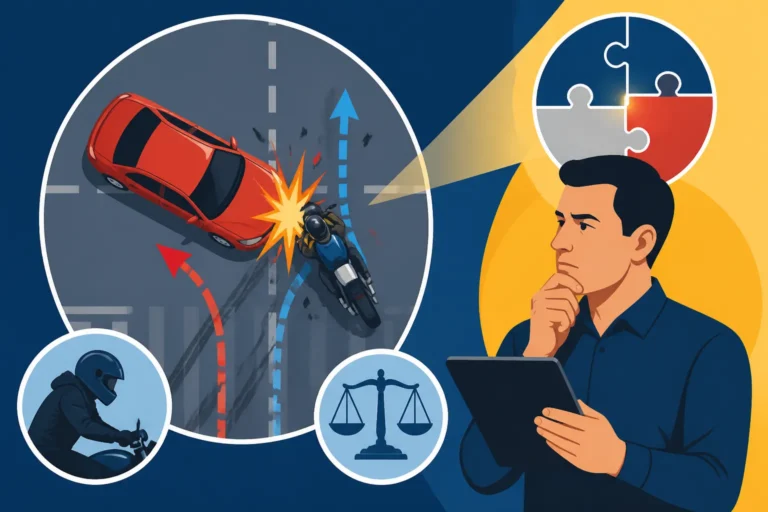
When you're involved in a motorcycle accident, the legal system needs a way to determine who caused the crash and to what extent each party contributed. This isn't always a straightforward "one person is 100% to blame" scenario. Sometimes, both drivers might have played a role, however minor, in the events leading up to the collision. This is where the doctrine of comparative negligence comes into play. It's a way for courts and insurance adjusters to allocate percentages of fault to each party involved in an accident. The core idea is that if you, the injured rider, are found to be partially responsible for the crash, your ability to recover damages from the other party might be reduced, or even completely barred, depending on the specific rules of the state where the accident occurred.
Think of it this way: imagine you’re riding down a busy street, sticking to the speed limit, but you briefly glance at your mirrors just as a car suddenly veers into your lane without signaling. While the car driver is clearly the primary cause, if it's argued that your momentary distraction contributed even slightly to your inability to react or avoid the collision, comparative negligence might be invoked. It acknowledges that accidents are often complex, and multiple factors can be at play, making the "Who Is at Fault in a Motorcycle Accident" question much more nuanced.
The Basic Principle of Shared Fault
At its heart, comparative negligence is about recognizing that fault can be shared. It's a departure from older legal systems, like contributory negligence, which were much harsher. Under contributory negligence, if you were found even 1% at fault for an accident, you couldn't recover any damages at all from the other party, regardless of how negligent they were. It was an all-or-nothing system that often felt incredibly unfair to accident victims who had suffered severe injuries.
The shift to comparative negligence was an attempt to create a more equitable system. Instead of completely barring recovery for a partially at-fault party, it allows them to still seek compensation, but that compensation is reduced in proportion to their degree of fault. So, if a jury determines you were 20% at fault for a crash, and your total damages are $100,000, you would only be able to recover $80,000 from the other driver. This proportional reduction aims to distribute the financial consequences of an accident more fairly based on each party's contribution to the incident.
Why It Matters for Motorcycle Riders
For motorcycle riders, understanding comparative negligence is absolutely critical. We're often unfairly stereotyped as reckless or negligent, even when we're riding defensively. Insurance companies, in particular, are notorious for trying to assign blame to riders, even in situations where the car driver was clearly negligent. They might argue you were speeding, "lane splitting" illegally, or simply "hard to see" – anything to reduce their payout. This inherent bias against motorcyclists makes the application of comparative negligence a constant battleground in personal injury claims.
If you don't know how these rules work, you could unwittingly accept a reduced settlement offer that doesn't fully cover your medical bills, lost wages, and pain and suffering. Being aware of the different types of comparative negligence and how they are applied can empower you to protect your rights and challenge unfair fault assignments. It’s a complex area, but a little knowledge can go a long way in ensuring you get the compensation you truly deserve after a crash. This is especially relevant in cases involving Lane Splitting and Motorcycle Accident Liability or even "I Didn't See the Motorcycle" Defense Explained.
Pure vs. Modified Comparative Negligence
While the general concept of comparative negligence allows for shared fault, not all states implement it in the same way. There are two primary variations: pure comparative negligence and modified comparative negligence. The difference between these two systems can have a profound impact on your ability to recover damages after a motorcycle accident. Understanding which rule applies in your state is paramount to navigating your claim effectively.
Pure Comparative Negligence
States that follow the pure comparative negligence rule allow an injured party to recover damages even if they are largely at fault for the accident. The key principle here is that your compensation is simply reduced by your percentage of fault, no matter how high that percentage is. There's no cutoff point where your claim is completely barred.
For example, imagine you're riding your motorcycle in California, a pure comparative negligence state. Another driver, distracted by their phone, swerves into your lane, causing a collision. However, during the investigation, it's determined that you were slightly speeding, contributing 10% to the accident. Under pure comparative negligence, if your total damages were $100,000, you would still be able to recover $90,000 from the other driver. Even if, hypothetically, a jury found you 90% at fault, you could still recover 10% of your damages. This system is seen as the most forgiving for injured parties, as it ensures some level of compensation even for those heavily contributing to their own injury. It’s a direct application of the idea that if someone else was any percentage at fault, they should pay for that percentage.
Modified Comparative Negligence
The majority of states operate under some form of modified comparative negligence. This system introduces a threshold: if your percentage of fault exceeds a certain limit, you are completely barred from recovering any damages. There are two common versions of modified comparative negligence: the 50% bar rule and the 51% bar rule.
The 50% Bar Rule
Under the 50% bar rule, also sometimes called the "not greater than" rule, you can recover damages only if your percentage of fault is 50% or less. If you are found to be 51% or more at fault, you cannot recover any compensation from the other party. Essentially, if you are equally or more responsible for the accident than the other party, your claim is barred.
Consider an accident in a state like Ohio, which uses the 50% rule. You're hit by a car, and your injuries total $75,000. If the jury finds you 40% at fault, you could recover $45,000 ($75,000 minus 40%). However, if the jury assigns you 50% of the fault, you would be able to recover $37,500. But if they determine you were 51% at fault, your claim would be completely barred, and you would receive nothing. This rule can be particularly harsh because even a slight increase in perceived fault can swing the outcome from partial recovery to no recovery at all.
The 51% Bar Rule
The 51% bar rule, often referred to as the "not as great as" rule, is slightly more lenient than the 50% rule. Under this system, you can recover damages as long as your percentage of fault is not greater than the combined fault of all other parties. In simpler terms, you can recover if you are 50% or less at fault. If you are found to be 51% or more at fault, your claim is barred.
Let's use an example in a state like Texas, which employs the 51% rule. If you're involved in a collision and sustain $120,000 in damages. If a jury determines you were 50% at fault, you could still recover $60,000. However, if they found you 51% at fault, you would, again, be completely barred from recovery. The practical difference between the 50% and 51% rule can feel small, but that single percentage point can mean the difference between getting some compensation and getting nothing. It's a critical distinction to grasp when evaluating your case. For a deeper dive, check out Pure vs Modified Comparative Negligence.
The table below summarizes the key differences between these systems:
| Type of Comparative Negligence | Fault Threshold for Recovery | Impact on Damages | Example |
|---|---|---|---|
| Pure Comparative Negligence | No threshold | Damages reduced by percentage of fault, regardless of how high. | If 90% at fault for $100k damages, still recovers $10k. |
| Modified (50% Bar Rule) | Must be 50% or less at fault | Damages reduced by percentage of fault; 51% or more fault bars recovery completely. | If 50% at fault for $100k damages, recovers $50k. If 51%, recovers $0. |
| Modified (51% Bar Rule) | Must be less than 51% at fault | Damages reduced by percentage of fault; 51% or more fault bars recovery completely. | If 50% at fault for $100k damages, recovers $50k. If 51%, recovers $0. |
How Comparative Negligence is Applied in Real-World Motorcycle Accidents
The theoretical understanding of comparative negligence is one thing, but seeing how it plays out in actual motorcycle accident claims is another. This is where the rubber meets the road, quite literally. When a crash occurs, law enforcement, insurance adjusters, and eventually, if necessary, courts will investigate and assign percentages of fault. This process is rarely straightforward, and it's heavily influenced by the evidence collected and the narratives presented by all parties involved.
Initial Fault Assessment by Law Enforcement
Often, the first official assessment of fault comes from the police report generated at the accident scene. Officers investigate, interview witnesses, take photographs, and document physical evidence. Based on their findings, they may issue traffic citations to one or more drivers, and often, the report itself will contain an officer's opinion on who was primarily at fault. While not definitive proof in a civil claim, this initial assessment carries significant weight with insurance companies.
However, police reports can sometimes be inaccurate or biased, especially against motorcyclists. An officer might arrive after the fact and rely on eyewitness accounts that misinterpret a rider's actions or a car driver's faulty memory. This is why it's crucial to understand How Police Reports Establish Fault and how they might affect your claim. If you feel the police report unfairly places blame on you, it’s vital to gather your own evidence and challenge that initial assessment.
Insurance Company Investigations
Once the police report is filed, the insurance companies get involved, and this is where comparative negligence truly comes into play. Each insurer will conduct its own investigation, often sending adjusters to the scene, reviewing police reports, medical records, and speaking with their policyholders and witnesses. Their primary goal, from their perspective, is to minimize the payout, and assigning partial fault to the motorcyclist is a common tactic to achieve this.
Insurance adjusters might argue that you were riding too fast, were in a blind spot you should have avoided, or that your gear wasn't sufficient, implying a contribution to your injuries. They look for any reason to reduce the amount they have to pay. For example, if a car made an illegal left turn in front of you, but the insurer claims you had enough time to stop or swerve, they're attempting to assign a percentage of fault to you. This back-and-forth negotiation on fault percentages is a major part of the claims process. This is why knowing How Insurance Companies Assign Blame to Riders is crucial for protecting your interests.
Judicial Determination of Fault
If the parties cannot agree on fault percentages, the case may proceed to litigation, and a judge or jury will ultimately make the determination. This typically involves presenting all available evidence, including expert testimony, accident reconstruction reports, and detailed accounts from witnesses. A jury, after hearing all the arguments, will be instructed on the state's comparative negligence laws and asked to assign a percentage of fault to each party.
This is where the distinction between pure and modified comparative negligence becomes critically important. In a pure comparative negligence state like Florida, if a jury found you 60% at fault, you would still recover 40% of your damages. However, in a modified comparative negligence state like Georgia with its 50% bar, if that same jury found you 51% at fault, your claim would be completely dismissed. The difference in these judicial outcomes can literally be hundreds of thousands of dollars, underscoring the high stakes involved in fault determination.
The Impact of Comparative Negligence on Your Settlement
When you've been injured in a motorcycle accident, the goal of a personal injury claim is to seek compensation for all the damages you've incurred. This includes economic damages like medical bills, lost wages, and property damage, as well as non-economic damages such as pain and suffering, emotional distress, and loss of enjoyment of life. However, if comparative negligence is applied to your case, it directly reduces the amount of compensation you can ultimately receive.
Direct Reduction of Your Payout
The most immediate and obvious impact of comparative negligence is the reduction of your settlement or award. As discussed, if you are found 25% at fault for an accident, and your total damages are assessed at $100,000, your potential recovery would be reduced by 25%, leaving you with $75,000. This reduction applies across the board to all categories of damages – your medical bills, your lost income, and even your pain and suffering.
This reduction can be particularly devastating for motorcyclists because our injuries tend to be more severe than those in car accidents. What might be minor damages for a car driver could translate to catastrophic injuries for a rider, leading to significant medical expenses and long-term care needs. A substantial reduction due to comparative negligence could mean the difference between affording necessary ongoing treatment and facing crippling financial debt. This is precisely How Comparative Negligence Reduces Your Payout.
Affecting Negotiation Strategies
The specter of comparative negligence looms large over all settlement negotiations. Insurance companies will almost always try to argue that you bear some fault, even if it's minimal, because any percentage they can assign to you directly reduces their financial liability. This becomes a key leverage point for them. They might offer a settlement figure that is already reduced by an assumed percentage of your fault, forcing you to either accept it or challenge their assessment.
Knowing your state's specific comparative negligence laws is crucial here. If you're in a pure comparative negligence state, while they'll still argue fault, you have the reassurance that some recovery is possible no matter your fault level. In a modified comparative negligence state, however, hitting that 50% or 51% threshold can be a deal-breaker, turning settlement negotiations into a high-stakes game of chicken. Both sides will be acutely aware of that threshold and will argue fiercely to keep your fault percentage below or above it, depending on their position. This is a common tactic in disputes where When Fault Is Disputed in a Motorcycle Crash.
Potential for Claim Barred Entirely
The most severe consequence of comparative negligence, particularly in modified comparative negligence states, is the complete denial of your claim. If a jury or insurance company determines that your percentage of fault crosses the specific threshold (e.g., 51% or more in a 51% bar rule state, or any percentage in the few remaining contributory negligence states), you will receive no compensation whatsoever for your injuries or damages.
Imagine you're involved in a collision caused by a driver who ran a red light, but you were found to be 55% at fault for speeding excessively. In a modified comparative negligence state, your extensive medical bills, property damage to your motorcycle, and lost wages could all go uncompensated. This outcome highlights the absolute necessity of diligently collecting evidence, understanding How Fault Is Determined in Motorcycle Accidents, and building the strongest possible case to minimize any potential fault assigned to you.
Challenging Fault Assignments and Protecting Your Claim
Given the potentially devastating impact of comparative negligence on your motorcycle accident claim, it's absolutely crucial to proactively challenge any unfair fault assignments. You can't just let insurance companies or police reports dictate your fate. Protecting your claim requires a strategic and diligent approach, starting from the moment the accident occurs.
Documenting the Scene Thoroughly
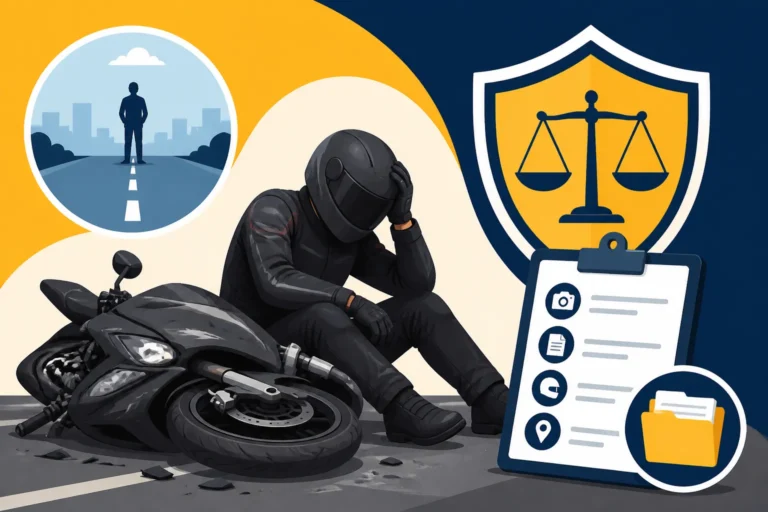
Your best defense against unfair fault is robust evidence. Immediately after an accident, if you are able, meticulously document the scene. Take comprehensive photos and videos from multiple angles, capturing:
- Damage to your motorcycle and the other vehicle(s).
- Skid marks, debris, and fluid trails on the road.
- Traffic signals, stop signs, and any relevant road markings.
- Weather conditions and road hazards.
- Your injuries and any visible damage to your riding gear, especially your helmet.
- The overall environment, including landmarks and traffic flow.
This visual evidence can be invaluable in reconstructing the accident and refuting claims that you were somehow at fault. For example, clear photos of the other driver's vehicle far over the center line can contradict claims of shared fault in a head-on collision. For more detailed guidance, consider reviewing Motorcycle Accident Evidence for Proving Fault.
Gathering Witness Statements
Independent witnesses can be incredibly powerful in disproving adverse fault claims. They often provide objective accounts that can counter biased statements from the other driver or initial police impressions. If possible, get contact information for anyone who saw the accident. Even a brief conversation to understand what they observed can be helpful.
Later, a skilled attorney can follow up with these witnesses to secure formal statements. For instance, if the other driver claims you were speeding, but a witness testifies they saw the car driver make an erratic lane change, that testimony can significantly shift the fault assessment. Understanding How Witnesses Affect Motorcycle Fault is a key component of building a strong case.
Seeking Medical Attention Immediately
Beyond protecting your health, immediate medical attention is vital for your claim. Delays in seeking treatment can be used by insurance companies to argue that your injuries weren't severe or that they weren't caused by the accident, thereby reducing your damages and potentially implying some negligence in your own care. Even if you feel fine right after the crash, adrenaline can mask serious injuries. Go to the emergency room or see a doctor as soon as possible.
Ensure all your symptoms, no matter how minor they seem, are documented in your medical records. These records provide objective proof of your injuries and their direct link to the accident, making it harder for the defense to minimize your damages or shift blame for the severity of your condition.
Never Admitting Fault
This is a golden rule: never, ever admit fault at the scene of an accident. Even a casual apology like "I'm so sorry, are you okay?" can be twisted by insurance companies into an admission of guilt. Stick to the facts when speaking with law enforcement and exchange insurance information with the other driver, but do not discuss who you think was responsible. You are likely in shock, and you don't have all the information yet.
Let the investigation unfold and the legal process determine fault. Any admission, however well-intentioned, can be used against you to increase your percentage of comparative negligence, directly impacting your settlement. This is why Why You Should Never Admit Fault at the Scene is such critical advice.
State-Specific Rules for Comparative Negligence
The legal landscape for comparative negligence varies significantly across the United States. What might allow you to recover substantial damages in one state could completely bar your claim in another, even for the exact same accident scenario. Understanding the specific fault laws in the state where your accident occurred is not just helpful; it's absolutely essential.
California's Pure Comparative Negligence
California is a prime example of a state that applies pure comparative negligence. This means that an injured motorcyclist can recover damages even if they are found to be 99% at fault for an accident. Their recovery will simply be reduced by their percentage of fault. This system is generally considered the most favorable for plaintiffs because it guarantees some level of compensation as long as another party bears any fault.
For instance, if you're riding your motorcycle on the Pacific Coast Highway in California and are involved in a collision where a jury deems you 70% at fault for misjudging a turn, but the other driver was 30% at fault for having bald tires, you could still recover 30% of your total damages. This flexible approach means that the focus shifts less on whether you can recover, and more on determining the precise percentage of fault to ensure an equitable distribution of costs. For more details specific to this state, see Motorcycle Accident Fault Laws in California.
Texas and the 51% Bar Rule
Texas, like many other states, follows a modified comparative negligence rule known as the 51% bar. In Texas, you can recover damages as long as your percentage of fault is 50% or less. If you are found to be 51% or more at fault for the accident, you are completely barred from recovering any compensation.
This rule demands a keen eye during investigation and negotiation. If you're riding in a busy area like Houston and are involved in a crash, an insurance company might aggressively try to push your fault percentage to 51% or higher to avoid paying out. For example, if a car pulled out in front of you, but they argue you were slightly speeding and could have reacted quicker, the difference between 49% and 51% fault is the difference between receiving a reduced settlement and receiving nothing at all. Riders need to be incredibly vigilant in protecting their claim under this rule, as illustrated in Motorcycle Accident Fault Laws in Texas.
Florida's Pure Comparative Negligence Rule
Florida also operates under the pure comparative negligence rule, similar to California. This means that if you're riding through Miami and get into an accident, your ability to collect damages will not be barred, even if you share a high percentage of fault. Your compensation will simply be reduced by the percentage of fault assigned to you.
This legal framework means that a rider who might be considered mostly at fault could still receive compensation for the portion of the accident attributable to the other party. While this doesn't excuse reckless behavior, it ensures that every party involved is held accountable for their specific contribution to the crash. It is important to remember that even in pure comparative negligence states, the higher your fault percentage, the lower your ultimate payout will be, impacting the real value of your settlement. You can learn more about Motorcycle Accident Fault Laws in Florida if you're in the Sunshine State.
Why Documentation is Your Best Friend in Comparative Negligence Cases
In the intricate dance of determining fault and damages, thorough documentation stands as your most steadfast ally. For motorcyclists, who often face an uphill battle against inherent biases, comprehensive evidence is not just helpful—it’s absolutely vital to counter any attempts to assign disproportionate blame through comparative negligence. Every piece of information you collect builds a stronger narrative, making it harder for opposing parties to diminish your claim.
Visual Evidence: Photos, Videos, Dashcam Footage
In today's world, our smartphones are powerful tools for documentation. Immediately after an accident, if you are physically able and it is safe to do so, use your phone to capture everything. Take dozens of photos and videos of the accident scene, from wide shots showing the overall intersection to close-ups of vehicle damage, road debris, skid marks, and traffic signs. Capture different angles and perspectives.
Crucially, also photograph your injuries, damaged riding gear (including your helmet, jacket, and pants), and the surrounding environment. Dashcam footage, if you have it, can be a game-changer. A high-quality dashcam can provide an irrefutable, objective account of the moments leading up to and during the collision, often proving fault or disproving false claims of rider negligence. This raw, unbiased visual record can be the most compelling evidence in your favor and directly counter arguments of shared fault. For more on this, look into How Dashcam Footage Proves Fault.
The Official Report: Police and Medical Records
Official reports from law enforcement and medical professionals form the backbone of your claim. The police report documents the scene, statements, and often provides an initial assessment of fault, sometimes even issuing citations. While not always flawless, it's a critical starting point. If you believe the report contains inaccuracies, it's important to understand How to Correct a Wrong Police Report.
Medical records are equally, if not more, important. They meticulously document your injuries, treatments, prognoses, and the associated costs. These records provide objective proof of the physical and financial toll the accident has taken. Ensure every injury, pain, and symptom is thoroughly documented. Any gaps in treatment or inconsistencies can be exploited by insurance companies to suggest your injuries aren't as severe or aren't directly related to the accident, influencing comparative fault arguments. This is why How Medical Records Support Your Claim is so important.
Your Personal Account: Journaling and Witness Contacts
Beyond official documents, your personal recollections and the accounts of others are indispensable. Start an accident journal as soon as possible, detailing everything you remember about the crash, your injuries, your medical appointments, pain levels, and how your daily life has been affected. Memories fade, and a detailed journal provides a consistent record over time.
Also, compile a list of all potential witnesses. This includes anyone who stopped at the scene, first responders, and even people in nearby businesses who might have observed something. Note their contact information and what they might have seen. The more consistent and compelling the narrative you build through these various forms of documentation, the stronger your position will be when confronting claims of comparative negligence and striving to prove When the Driver Is Clearly at Fault.
Working with an Attorney in Comparative Negligence Cases
Navigating the complexities of comparative negligence after a motorcycle accident can be overwhelming, especially when you're also dealing with painful injuries and mounting medical bills. This is where an experienced motorcycle accident attorney becomes not just an asset, but a necessity. They understand the nuances of these laws and how insurance companies operate, allowing you to focus on your recovery while they fight to protect your rights.
Expertise in State-Specific Laws
One of the most significant benefits of hiring a dedicated motorcycle accident lawyer is their in-depth knowledge of the specific comparative negligence laws in your state. As we've discussed, whether your state follows pure, 50% modified, or 51% modified rules can fundamentally alter the outcome of your case. A local attorney will know exactly how these laws are applied in your jurisdiction, what precedents exist, and how judges and juries typically interpret them.
This specialized knowledge allows them to anticipate arguments from the defense, effectively counter attempts to assign you undue fault, and accurately calculate the potential value of your claim under your state's specific legal framework. They understand how Motorcycle Accident Fault Laws in Florida or Motorcycle Accident Fault Laws in Pennsylvania might differ, and how those differences impact your case strategy.
Skillful Negotiation with Insurance Companies
Insurance companies are not on your side; their business model is built on minimizing payouts. They are expert negotiators and will use every tactic to reduce their liability, including aggressively pushing a comparative negligence argument against you. Trying to negotiate with them on your own, especially while recovering, can be a recipe for disaster.
An attorney levels the playing field. They speak the language of insurance adjusters, understand their strategies, and know how to present your case in the most compelling way possible. They can effectively challenge unfair fault assignments, present strong evidence to support your version of events, and fight for a fair settlement that accurately reflects your damages after accounting for any legitimate shared fault. Their experience in dealing with these entities can significantly improve your chances of a favorable outcome and protect you from lowball offers.
Gathering and Presenting Evidence to Prove Fault
Building a strong case that minimizes your comparative fault requires meticulous evidence collection and presentation. An attorney has the resources and expertise to investigate your accident thoroughly. This includes:
- Obtaining and reviewing police reports, traffic camera footage, and medical records.
- Interviewing witnesses and securing sworn statements.
- Working with accident reconstruction experts to analyze the scene and determine precisely how the crash occurred.
- Subpoenaing phone records or other evidence from the at-fault driver to prove distraction or impairment.
They know what evidence is admissible in court and how to present it effectively to demonstrate the other driver's negligence while mitigating any fault attributed to you. This comprehensive approach is crucial for establishing How Fault Is Determined in Motorcycle Accidents and maximizing your potential compensation. For those considering litigation, an attorney can also advise on When to Hire an Accident Reconstruction Expert.
Disclaimer
Please remember that this article provides general information and insights into comparative negligence in motorcycle accidents. It is not intended as legal advice. Every accident case is unique, and the laws surrounding comparative negligence can vary significantly by state and specific circumstances. For personalized guidance regarding your specific situation, it is crucial to consult with a qualified motorcycle accident attorney in your jurisdiction. They can provide legal advice tailored to your case and help you understand your rights and options.