What Happens If You Were Lane Splitting
When you’re a rider, the open road is freedom, but sometimes, traffic can turn that freedom into a frustrating crawl. Lane splitting, or white-lining, seems like a logical solution, allowing you to bypass congested vehicles safely. However, if you've been in a motorcycle accident while lane splitting, you're likely filled with questions and anxieties about what this means for your claim. This guide aims to clear up the confusion, providing an in-depth look at how lane splitting impacts fault, liability, and your ability to recover damages after a crash.
Understanding Lane Splitting Laws and Their Impact on Fault
One of the biggest misconceptions and sources of stress for riders involved in a lane-splitting accident is the immediate assumption of fault. It's a natural fear, especially since many people, including some law enforcement and insurance adjusters, don't fully understand the nuances of these laws. However, the legal status of lane splitting and how you executed it are absolutely critical to how your accident claim will unfold.
Legal Status of Lane Splitting by State
The first and most important thing to understand is whether lane splitting is even legal where your accident occurred. This isn't a uniform national rule; it's a state-by-state patchwork, and it's constantly evolving in some places. What's perfectly acceptable in one state could land you a ticket, or worse, be used against you in another.
For instance, California has historically been the pioneer, being the first state to explicitly legalize lane splitting. Riders there can legally ride between lanes of stopped or slow-moving traffic on freeways. However, even in California, there are guidelines – for example, it’s generally recommended that riders not lane split at speeds more than 10 mph faster than the surrounding traffic, and only when traffic is moving at 30 mph or less. These aren't strict laws but rather safety guidelines from the California Highway Patrol, which can still be used to argue safe riding practices. On the flip side, states like Arizona, Texas, and New York explicitly prohibit lane splitting, considering it an unsafe maneuver. Then you have a gray area in other states where there are no specific laws addressing it, meaning it's neither explicitly legal nor illegal, often left to the discretion of local law enforcement or court interpretation.
Knowing the specific laws in your state is paramount. If you were involved in a crash while lane splitting in a state where it's explicitly illegal, that fact will likely be brought up immediately by the other driver's insurance company or even the responding police officer. This doesn't automatically make you at fault for the entire accident, but it certainly complicates things and can create an uphill battle. If you were lane splitting legally, adhering to all state-specific guidelines, then the conversation shifts dramatically. This foundational legal status is the springboard from which all other fault discussions will launch. It sets the stage for whether the act of lane splitting itself is seen as a contributing factor or simply a permitted mode of travel.
How Lane Splitting Laws Affect Initial Fault Assessments
The moment a police officer arrives at the scene of an accident, they begin to gather information and make initial assessments. If you were lane splitting, especially if it was illegal in that state, that fact often enters the equation very early on. This can sometimes lead to a bias against the rider. Police officers, like anyone else, might have preconceived notions about lane splitting, and if it's illegal, they might be more inclined to assign some degree of fault to the motorcyclist in their accident report. This is where understanding your rights and how to communicate effectively, without admitting fault, becomes crucial immediately after a crash.
Similarly, insurance companies will immediately look at the police report and the circumstances surrounding the accident. If the report indicates you were lane splitting in a state where it's unlawful, they will almost certainly use this against you to try and deny your claim or reduce your settlement. They'll argue that your actions contributed to the accident, even if the primary cause was the other driver's negligence, such as an unsafe lane change or not checking their mirrors. This initial assessment by both law enforcement and insurers can feel incredibly unfair, especially when you know you were riding defensively, but it's a reality riders often face. It underscores why accurately documenting the scene and knowing the specific laws around Lane Splitting Legality and Fault by State are so important. The challenge often lies in overcoming these initial hurdles and proving that even if you were lane splitting, the other driver still had a duty of care and their actions were the direct cause of the collision.
How Lane Splitting Influences Accident Liability and Damages
Even if lane splitting is legal in your state, or if the illegality doesn't automatically mean you're 100% at fault, your involvement in this maneuver can significantly influence how liability is assigned and, consequently, the amount of damages you can recover. This is where legal doctrines like comparative negligence come into play, which vary widely and can drastically impact your potential settlement.
Contributory and Comparative Negligence Doctrines
The legal landscape concerning fault in an accident can be tricky, especially when an action like lane splitting is involved. Most states operate under some form of comparative negligence. This means that if you, the motorcyclist, are found to be partially at fault for the accident, your recoverable damages might be reduced by your percentage of fault. For example, if you sustain $100,000 in damages but are found to be 20% at fault for the crash, you might only be able to recover $80,000. This is a common mechanism in many states, including California and Florida, that prevents a rider from being completely barred from recovery just because they had some role in the incident.
However, it's not always so straightforward. There are different types of comparative negligence. Some states, like California, follow "pure comparative negligence," meaning you can recover damages even if you're 99% at fault, though your payout would be severely reduced. Other states, like Texas, use a "modified comparative negligence" rule, often referred to as the "51% rule." Under this rule, if you are found to be 51% or more at fault, you cannot recover any damages at all. A few rare states, like North Carolina, still adhere to "contributory negligence," which is much harsher: if you contribute any amount to the accident, even 1%, you are completely barred from recovering damages. Understanding these distinctions is paramount because how Comparative Negligence in Motorcycle Accidents is applied directly impacts your financial recovery.
Even if lane splitting is legal, the way you executed it can lead to an argument for shared fault. For instance, if you were lane splitting at an excessive speed for the conditions, or if you made a sudden maneuver, an insurance company or court might argue that your actions contributed to the collision, even if the other driver was also negligent. The defense might claim you were speeding, failed to anticipate a vehicle changing lanes, or weren't exercising due care, creating a situation where a shared fault scenario becomes very likely. This is where the narrative around the accident becomes critically important, and why it's not just about if you were lane splitting, but how you were lane splitting.
Proving Negligence and Causation in Lane Splitting Accidents
Regardless of the lane splitting legality, the core of any motorcycle accident claim still revolves around proving negligence and causation. That means demonstrating that the other driver's actions were negligent and that their negligence directly caused your injuries and damages. This can be particularly challenging in lane splitting scenarios because of the inherent biases against motorcyclists and the often-complex dynamics of the crash.
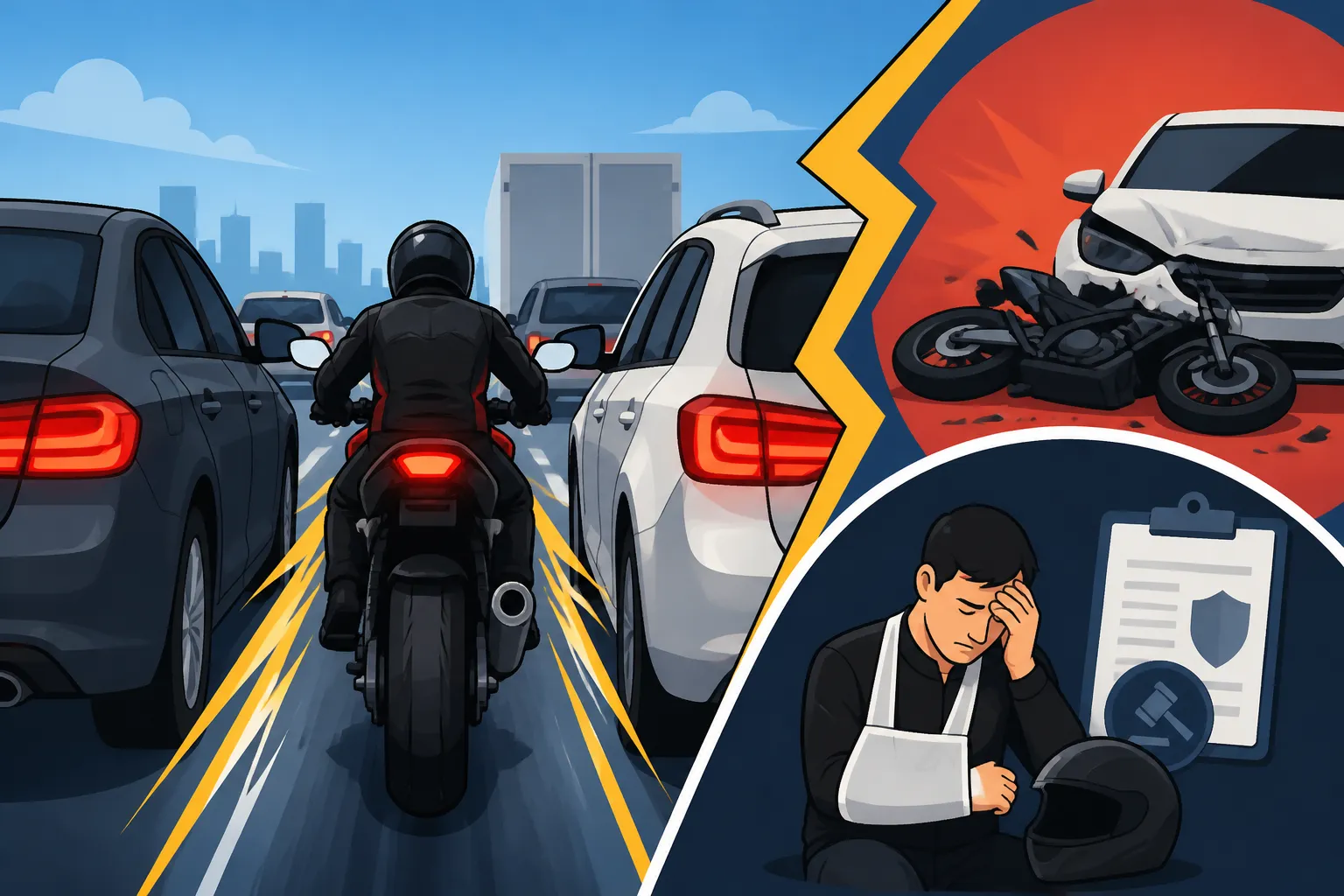
Imagine a scenario: You are legally lane splitting between two lanes of slow-moving traffic on Interstate 5 in California. Suddenly, a driver in a large pickup truck, distracted by their phone, decides to change lanes without checking their mirrors, swerving into your path and causing a collision. In this situation, despite your lane splitting, the primary fault lies with the distracted driver for making an unsafe lane change. You were operating within the bounds of the law, and their negligence was the direct cause. The challenge is to prove this definitively.
This often requires robust evidence. You'll need to show that the other driver failed in their duty of care – perhaps by not looking, not signaling, or by following too closely. Crucial evidence can include witness statements, dashcam footage (if available from either vehicle or surrounding cars), traffic camera footage, and even accident reconstruction reports. For example, if you can get a witness to testify that the car suddenly swerved into your lane without a signal, it significantly strengthens your case. If your own helmet cam or a nearby vehicle's dashcam captured the incident, that's often gold for proving the sequence of events. The aim is to shift the focus from your act of lane splitting to their negligent action that directly caused the crash. The fact that you were riding between lanes, even if legally, often gives insurance companies an angle to try and assign Shared Fault in Motorcycle Accidents, so a strong evidence-based counter-narrative is absolutely essential.
Practical Steps and Considerations After a Lane Splitting Accident
Getting into any accident is disorienting and stressful, but a lane splitting accident can add layers of complication and anxiety. Knowing what to do in the immediate aftermath can make a significant difference in how your claim proceeds and whether you can effectively counter arguments of fault against you.
Documenting the Scene and Gathering Evidence
The first moments after a motorcycle accident are chaotic, but they are also incredibly important for gathering evidence. If you're able and safe to do so, document everything. This means taking clear, well-lit photos and videos of the accident scene from multiple angles. Don't just focus on your damaged bike or your injuries. Capture the positions of all vehicles involved before they are moved. Get photos of any skid marks, debris on the road, traffic signs, and road conditions. If the other driver moved their vehicle before police arrived, note that.
Specifically for lane splitting accidents, try to document:
- Traffic Speed and Flow: Were cars stopped or moving slowly? At what speed were you splitting?
- Your Position: Where exactly were you in relation to the vehicles when the impact occurred?
- Road Width: How much space did you have?
- Other Driver's Vehicle: Damage points, and if possible, their rearview or side mirrors. Did they have visibility issues?
- Witnesses: Get names and contact information from anyone who saw the accident, especially if they saw the other driver's actions before the crash. Their testimony could be invaluable in disputing claims that you were at fault.
Remember, the police report is a critical piece of evidence. Make sure the officer notes down all relevant details, including the legal status of lane splitting in your area and the conditions under which you were doing it. If the officer makes an assumption about fault that you disagree with, you can state your perspective without being confrontational. This meticulous documentation directly supports your ability to Prove Fault in a Motorcycle Accident and can be crucial in challenging any unfair blame placed on you due to lane splitting.
Dealing with Insurance Companies and Potential Bias
This is where things can get really frustrating. Insurance companies are businesses, and their goal is to pay out as little as possible. When a motorcycle is involved, especially in a lane splitting scenario, they often operate with a significant "rider bias." They might jump to conclusions, assuming the motorcyclist was speeding, reckless, or inherently at fault simply because they were on a motorcycle or splitting lanes. This can lead to them issuing lowball settlement offers or even denying your claim outright.
When an insurance adjuster contacts you, be polite but guarded. Do not admit fault or make any statements that could be misinterpreted as such. Stick to the facts you've gathered. You don't have to provide a recorded statement, and it's generally advisable not to until you've spoken with a legal professional. The adjuster might try to use your own words against you, picking apart phrases to imply you contributed to the accident. They might even try to suggest that because you were lane splitting, you inherently put yourself in a dangerous position, regardless of the other driver's actions.
Be prepared for them to question your speed, your awareness, and your decision-making. If lane splitting is illegal in your state, they will absolutely use that as leverage. If it's legal, they might still argue you weren't doing it safely or properly. This is why having strong evidence and a clear narrative is so vital. You need to be able to counter their assertions with concrete facts, eyewitness accounts, and professional assessments. It's a frustrating dance, but knowing their tactics can help you navigate it more effectively and protect your right to fair compensation. It's not uncommon for insurers to Assign Blame to Riders unfairly, and being aware of this can help you prepare.
Seeking Legal Guidance for Your Lane Splitting Accident Claim
Navigating the aftermath of a motorcycle accident, particularly one involving lane splitting, is not just about physical recovery; it's also about a complex legal and financial battle. The stakes are often high, given the severe injuries commonly associated with motorcycle crashes. This is precisely why professional legal guidance can be indispensable.
The Value of a Motorcycle Accident Attorney
When you've been in a lane splitting accident, you're not just up against another driver; you're often up against an entire insurance company, which has vast resources and experienced legal teams dedicated to minimizing payouts. This is where a skilled motorcycle accident attorney becomes your most powerful advocate. They understand the intricacies of Motorcycle Accident Liability: A Complete Guide and specifically Lane Splitting and Motorcycle Accident Liability, including state-specific laws and how they're applied in court.
A good attorney can immediately step in and handle all communications with insurance companies, protecting you from inadvertently saying something that could harm your claim. They know how to counter the pervasive Rider Bias in Fault Determination, presenting your case in a way that highlights the other driver's negligence rather than focusing solely on your lane splitting. They can:
- Investigate thoroughly: This includes reviewing police reports, traffic camera footage, and witness statements, and, if necessary, hiring accident reconstruction experts to definitively prove how the crash occurred and who was at fault.
- Gather critical evidence: Beyond what you collect at the scene, attorneys can subpoena phone records (to prove distracted driving), obtain black box data from vehicles, and consult with medical professionals to accurately document the full extent of your injuries and their long-term impact.
- Negotiate aggressively: They understand how to value your claim accurately, accounting for all economic and non-economic damages, and they won't shy away from taking your case to trial if a fair settlement cannot be reached.
Their expertise can transform a seemingly bleak situation into a successful recovery of damages. They often have established relationships with experts who can provide testimony, such as engineers or medical professionals, strengthening your position considerably.
Maximizing Your Claim Despite Lane Splitting Involvement
Even if you were partially at fault due to lane splitting, it doesn't mean your claim is worthless. The goal is to maximize your recovery by clearly demonstrating the other driver's primary negligence and thoroughly documenting all your damages. An attorney will focus on several key areas:
-
Challenging Fault Allocation: If you've been unfairly assigned a high percentage of fault, your attorney can work to challenge this. This often involves detailed accident reconstruction, using physics and engineering principles to show that even if you were lane splitting, the other driver's actions (e.g., sudden lane change without looking) were the direct cause of the collision. They can argue that you were exercising reasonable care, even within the context of lane splitting, and that the other driver had a duty to see you and avoid the crash.
-
Comprehensive Damage Calculation: Motorcycle accidents often result in severe injuries. Your attorney will ensure all your damages are accounted for, including:
- Medical Expenses: Past and future medical bills, including emergency care, surgeries, physical therapy, medication, and long-term rehabilitation.
- Lost Wages: Income lost due to inability to work, and future lost earning capacity if your injuries prevent you from returning to your previous job or working at all.
- Pain and Suffering: Compensation for physical pain, emotional distress, mental anguish, loss of enjoyment of life, and other non-economic damages. These are often significant in motorcycle cases due to the traumatic nature of the injuries.
- Property Damage: Cost to repair or replace your motorcycle, as well as damaged gear.
-
Navigating Legal Complexities: Your attorney can explain How Comparative Negligence Reduces Your Payout, ensuring you understand how any assigned fault might affect your final settlement. They will fight to minimize your percentage of fault and maximize the damages attributed to the other party. They can also explore other avenues for compensation, such as uninsured/underinsured motorist (UM/UIM) coverage, if the at-fault driver has insufficient insurance.
Ultimately, your focus should be on your recovery. Let a seasoned legal professional handle the intricate legal battle. If you're wondering, "Do You Need a Motorcycle Accident Lawyer?", especially after a lane splitting incident, the answer is almost always yes. Their expertise can be the difference between a denied claim and a substantial settlement that covers your losses and helps you rebuild your life.
State/Region Lane Splitting Legality Impact on Accident Fault (General) Causal factors.
California Legal with guidelines If done per guidelines, less likely to be solely at fault. However, execution is key. If illegal, higher chance of fault. If legal, still liable for unsafe practice. If illegal, you may be considered at fault, potentially barring recovery or reducing it significantly. If legal, the other driver's actions are key to fault. However, if your lane splitting was unsafe (e.g., too fast), you could still share fault.
Arizona Prohibited High likelihood of being assigned fault or significant comparative fault, reducing or barring recovery.
Texas Prohibited See above. If illegal, a strong chance of full or partial fault. If legal, liability depends on safe operation and whether unsafe operation contributed to the incident. The driver involved can face criminal charges for unlawful lane splitting, but the primary factor for accident fault will focus on whether their specific action (like an unsafe lane change) caused the crash. The rider may still be partially at fault if their speed or actions were also unsafe.
New York Prohibited See above. If prohibited, the rider faces potential comparative or contributory negligence. The other driver's fault still depends on their role (e.g., failure to yield). If illegal, you may be seen as partially responsible. However, the critical point is whether the other driver caused the accident. If legal, liability hinges on who acted negligently. It depends. If legal, the fault lies with the driver whose actions caused the crash. If illegal, you may share some fault.
Other States Undefined or various laws If undefined, a higher chance of partial or full fault depending on the specific circumstances and judicial interpretation. The driver's fault is assessed based on normal traffic laws, not their lane splitting. However, if the lane splitting was illegal or unsafe, it could lead to shared fault. If illegal, you could be partially responsible. If legal, the crucial element is what the other driver did.
Disclaimer: This information is for general guidance only and does not constitute legal advice. Laws regarding motorcycle accidents and liability vary by state and jurisdiction. It is crucial to consult with a qualified attorney to discuss the specific details of your situation.