Motorcycle Accident Fault Laws in New Jersey
Navigating the aftermath of a motorcycle accident is tough enough, but trying to understand who's at fault, especially when you're in a specific state like New Jersey, can feel like trying to solve a puzzle while riding a unicycle. It's frustrating when you're already dealing with injuries and bike damage, only to be met with confusing legal jargon. This comprehensive guide will break down the motorcycle accident fault laws in New Jersey, explaining how fault is determined, how it affects your claim, and what you need to know to protect your rights.
Understanding New Jersey's "Modified Comparative Negligence" System
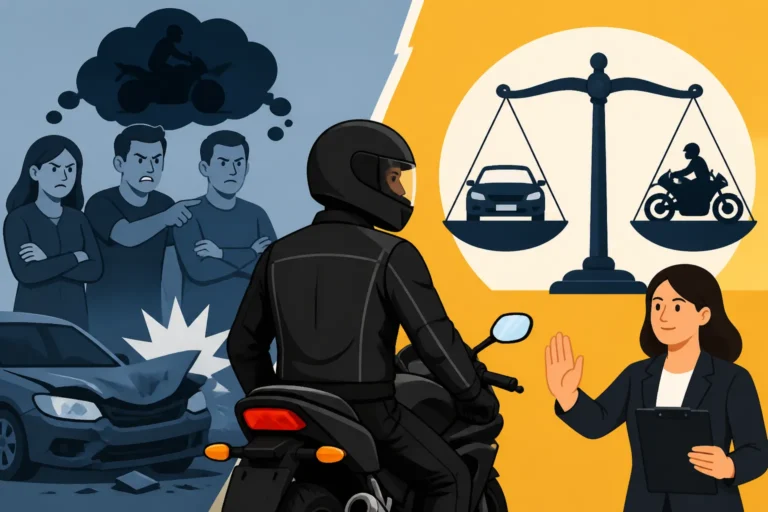
One of the first things you need to wrap your head around when it comes to motorcycle accident claims in New Jersey is the state's approach to shared fault. Unlike some states that have strict "all-or-nothing" rules, New Jersey operates under a system known as "modified comparative negligence." This means that if you're found to be partly responsible for the accident, you can still recover damages, but your compensation will be reduced by your percentage of fault. However, there's a crucial limit to this.
How the 51% Rule Works in New Jersey
The "modified" part of New Jersey's comparative negligence system refers specifically to the "51% rule." What this means is that if you are determined to be 51% or more at fault for the motorcycle accident, you are legally barred from recovering any damages from the other party. Think of it like a line in the sand: if you step over that 50% mark and are found to be even slightly more responsible than the other driver, your claim for compensation disappears entirely.
For instance, imagine you're riding through Trenton, and a car suddenly cuts you off, causing a collision. Initially, it seems the car driver is entirely to blame. However, during the investigation, it's discovered that you were slightly speeding, perhaps going 5-10 miles over the limit. A jury or insurance adjuster might decide the car driver was 70% at fault for failing to yield, but you were 30% at fault for speeding. In this scenario, because your fault is below 51%, you could still recover 70% of your total damages. Now, if they somehow determined you were 52% at fault, even if the other driver was clearly negligent, you'd walk away with nothing. This is a critical detail that often catches riders off guard and can be a significant point of contention with insurance companies. Understanding How Comparative Negligence Reduces Your Payout is essential.
Practical Implications for Your Claim
The 51% rule has enormous practical implications for any motorcycle accident claim in New Jersey. It means that establishing fault isn't just about proving the other driver was negligent; it's also about minimizing any potential blame that could be assigned to you. Insurance companies, especially those representing the at-fault driver, will go to great lengths to try and push your percentage of fault over that 50% threshold. They might argue you were speeding, lane splitting illegally, or simply not paying enough attention.
This is why every piece of evidence matters, from photographs of the scene to witness statements. Your ability to clearly demonstrate that the other driver's actions were the primary cause of the accident, and that your own actions were minimal or irrelevant to the crash, is paramount. If you're injured in a crash near the Jersey Shore, for example, and the other driver tries to claim you were riding recklessly, you'll need strong evidence to counter that narrative. When a Rider Is Partially at Fault it changes the entire dynamic of the claim.
Proving Fault in a New Jersey Motorcycle Accident
Proving who is at fault in a motorcycle accident in New Jersey often feels like an uphill battle. There's a persistent bias against motorcyclists that sometimes influences how accidents are perceived. You might hear the phrase "I didn't see the motorcycle," which is a common defense drivers use, unfortunately shifting blame. Successfully navigating a claim requires a clear understanding of what evidence is crucial and how to present it effectively. This is where truly understanding How Fault Is Determined in Motorcycle Accidents becomes incredibly important.
Key Evidence for Establishing Liability
Gathering robust evidence is the backbone of any motorcycle accident claim in New Jersey. The more compelling and concrete your evidence, the harder it is for insurance companies to dispute liability or assign undue blame to you.
Here’s a breakdown of what you should focus on:
- Accident Scene Photos and Videos: In the immediate aftermath, if you are able, use your phone to capture everything. This includes damage to all vehicles, skid marks, road conditions, traffic signs, debris, and the surrounding environment. Try to get photos from multiple angles and distances. These visuals provide an undeniable snapshot of the scene that can speak volumes.
- Witness Statements: Independent witnesses can be incredibly valuable, especially if they saw the entire incident unfold. Their unbiased perspective can corroborate your account and often counter the "I didn't see the motorcycle" defense. Get their contact information immediately if possible.
- Traffic Camera Footage: Many intersections, especially in busier New Jersey cities like Newark or Jersey City, have traffic cameras. Footage from these cameras can be a game-changer, offering an objective view of how the accident occurred.
- Dashcam Footage: If either your motorcycle or the other vehicle had a dashcam, that footage is gold. It provides real-time, undeniable evidence of the events leading up to and during the collision.
- Medical Records: Your medical records are crucial for documenting your injuries, treatment, and prognosis. They link your injuries directly to the accident and quantify the physical toll it has taken.
- Property Damage Estimates: Detailed estimates for the repair or replacement of your motorcycle, helmet, and any other damaged gear help establish the extent of the impact and the financial cost.
- Expert Reconstruction: In complex cases, especially those with significant disputes over fault, an accident reconstruction expert can analyze all available data—skid marks, vehicle damage, debris fields—to scientifically determine the sequence of events and assign fault.
For a comprehensive list, you should refer to Motorcycle Accident Evidence for Proving Fault.
The Role of Police Reports and Witness Statements
The police report is often the first official document generated after an accident, and it carries significant weight with insurance adjusters. When police respond to a crash in New Jersey, they will investigate, speak to drivers and witnesses, and document their findings in a report. This report typically includes details about the date, time, and location of the accident, a diagram of the scene, and a preliminary assessment of who violated traffic laws. For example, if the report indicates the other driver failed to yield while making a left turn, it provides strong initial support for your claim that they were at fault in a Left-Turn Motorcycle Accidents Explained scenario.
However, it's crucial to understand that a police report isn't always the final word on fault. While it's an important piece of evidence, it’s often based on preliminary findings. Sometimes, an officer might make an error or not have the full picture. If you believe the police report inaccurately assigns blame or overlooks critical details, it's possible to seek an amendment, though this can be challenging.
Witness statements, on the other hand, offer personal accounts that can either bolster or contradict the police report. An independent witness who saw the whole thing can provide details that the police might have missed or misinterpreted, especially if the officer arrived after the fact. For instance, if a witness clearly saw the other driver distracted by their phone before the collision, that detail could significantly strengthen your position that they were primarily responsible. Conversely, if a witness incorrectly remembers events, their statement could inadvertently harm your case. This is why getting accurate contact information and asking them to write down what they saw at the scene, if possible, is so important.
How Insurance Companies Handle Fault in New Jersey
Dealing with insurance companies after a motorcycle accident in New Jersey can be incredibly frustrating. They aren't always on your side, and their primary goal is often to minimize their payout. This often leads to disputes over fault, where they try to shift as much blame as possible onto the motorcyclist. Knowing How Insurance Companies Assign Blame to Riders can help you prepare.
Common Tactics Insurers Use Against Riders
Insurance companies have a playbook when it comes to motorcycle accident claims, and it's essential to be aware of their tactics. Their goal is to reduce their liability, and in a modified comparative negligence state like New Jersey, that means trying to push your fault over the 50% mark or at least minimize the total damages they have to pay out.
Some common tactics include:
- Rider Bias: This is perhaps the most insidious tactic. Insurers often play into common stereotypes about motorcyclists being reckless or irresponsible. They might imply that you were speeding, weaving through traffic, or simply "being a biker," regardless of the actual evidence. They leverage the general public's perception to suggest you contributed more to the accident than you did.
- Demanding Early Recorded Statements: They will often call you soon after the accident, seemingly sympathetically, asking for a recorded statement. While it might feel polite to cooperate, anything you say can and will be used against you. An adjuster might ask leading questions designed to elicit responses that could be interpreted as an admission of partial fault. For example, if you say "I didn't see him until it was too late," they might try to twist that into an admission of inattention, even if it was simply a reaction to a sudden, unavoidable situation.
- Delay, Deny, Defend: This is a classic insurance strategy. They might delay investigating your claim, deny certain aspects of your injuries or damages, or aggressively defend their insured, hoping you'll get frustrated and accept a lower settlement. Delays can be particularly damaging if you're racking up medical bills and losing wages.
- Lowball Settlement Offers: Once they've done their "investigation" (which might involve selectively interpreting evidence), they'll often present a low initial settlement offer, hoping you'll take it out of desperation or lack of knowledge about your claim's true value. This offer rarely accounts for all your current and future damages, including pain and suffering.
- Requesting Extensive Medical Records: While they need your medical records to assess your injuries, they might request an overly broad range of past medical history, looking for pre-existing conditions they can blame for your current injuries, even if those conditions were entirely unrelated to the accident.
Recognizing these tactics is the first step in protecting your claim. It's why many riders choose to involve an attorney who understands these games and can advocate on their behalf.
The Impact of "No-Fault" on Motorcycle Claims
New Jersey is also a "no-fault" state when it comes to car insurance, which can add another layer of confusion for motorcycle accident victims. In a traditional no-fault system for cars, your own insurance typically pays for your medical expenses and lost wages, regardless of who caused the accident. This is known as Personal Injury Protection (PIP) coverage.
However, here's the critical distinction for motorcyclists: motorcycle insurance in New Jersey is generally not subject to the state's no-fault PIP requirements. This means that if you're injured in a motorcycle accident in New Jersey, you typically cannot claim benefits from your own motorcycle insurance policy for medical expenses or lost wages under PIP. Instead, you'll need to rely on your personal health insurance or seek payment from the at-fault driver's liability insurance.
This often means that motorcyclists in New Jersey, even for minor injuries, must directly pursue a liability claim against the at-fault driver to recover compensation for their medical bills, lost wages, and pain and suffering. This makes proving fault even more critical, as your recovery is almost entirely dependent on successfully establishing the other driver's negligence. It removes the "safety net" of immediate PIP benefits that car drivers might have.
This distinction underscores why understanding who is at fault in a motorcycle accident is so paramount for New Jersey riders. It directly impacts your ability to get your medical bills covered and recover for your other losses.
Specific Scenarios and New Jersey Fault Laws
While the general principles of modified comparative negligence apply to all motorcycle accidents in New Jersey, certain common scenarios have their own nuances when it comes to determining and proving fault. It's often not as simple as it seems, and understanding the specific laws and common pitfalls for each type of incident can make a big difference in your claim.
Left-Turn Collisions and Failure to Yield
Left-turn collisions are tragically common for motorcyclists, and in New Jersey, as in most states, the car driver making the left turn is often presumed to be at fault. This is because drivers making left turns across oncoming traffic have a duty to yield the right-of-way to vehicles coming from the opposite direction, including motorcycles. When a driver fails to yield, they are typically deemed negligent. For a deep dive into this, you might want to look into Motorcycle Accidents Caused by Left-Turn Collisions.
However, even in clear-cut left-turn scenarios, an insurance company might still try to assign partial fault to the motorcyclist. They might argue you were speeding, that your headlight wasn't on, or that you were in their blind spot. For example, if you were riding through a busy intersection in Camden and a car turned directly in front of you, the driver's insurance might try to claim you were going too fast to stop, even if they clearly violated your right-of-way.
To counter these arguments and prove the driver's fault in a left-turn collision, you'll need evidence such as:
- Witness statements: Especially from those who saw the other driver fail to yield.
- Traffic camera footage: If available, this can clearly show who had the right-of-way.
- Skid marks and point of impact: These can help accident reconstructionists determine speeds and movements.
- Your own consistent testimony: Stick to the facts of the other driver's failure to yield.
It's also worth noting that New Jersey law specifically addresses "failure to yield" as a traffic violation. If the police report cites the other driver for this violation, it strengthens your position significantly, as How Traffic Violations Affect Fault can play a substantial role.
Road Hazards and Government Liability
Sometimes, a motorcycle accident isn't solely the fault of another driver, but rather caused or exacerbated by dangerous road conditions. New Jersey roads, like any others, can present hazards such as potholes, unmarked construction zones, debris, or malfunctioning traffic signals. When these hazards contribute to a crash, it opens the door to potential claims against a government entity—the state, county, or a local municipality. This is where Government Liability for Road Hazards comes into play.
Consider a situation where you hit a massive, unmarked pothole on a county road outside of Princeton, causing you to lose control and crash. While no other driver was directly involved, the pothole was a direct cause of your accident. In such a case, you might have a claim against the government entity responsible for maintaining that road.
However, suing a government entity for a road hazard is significantly more complex than suing a private individual. Government entities in New Jersey are protected by sovereign immunity, which means they generally can't be sued unless specific exceptions apply. These exceptions often require proving:
- Actual or constructive notice: The government entity must have known about the dangerous condition (actual notice) or should have known about it through reasonable inspection (constructive notice). This means they can't simply claim ignorance.
- Dangerous condition: The road hazard must meet the legal definition of a dangerous condition, not just a minor imperfection.
- Proximate cause: The dangerous condition must have been a direct and substantial cause of your accident and injuries.
- Timely notice of claim: There are strict, often very short, deadlines for filing a formal "notice of claim" with the relevant government body (usually 90 days from the date of the accident in New Jersey). Missing this deadline can permanently bar your claim.
If you believe a road hazard contributed to your motorcycle accident in New Jersey, documenting the scene is crucial. Take photos of the hazard itself, its location, and any warning signs (or lack thereof). Also, make note of the exact date and time, as this can help establish when the government should have known about the issue.
Summary of New Jersey Fault Laws
To help consolidate some of this information, here's a quick table summarizing key aspects of New Jersey's motorcycle accident fault laws:
| Aspect | Explanation | Impact on Your Claim |
|---|---|---|
| Fault System | Modified Comparative Negligence | You can recover damages even if partially at fault. |
| 51% Rule | If you are 51% or more at fault, you cannot recover any damages. | Critical threshold; insurers will try to push your fault above this. |
| Motorcycle PIP | Motorcycle insurance is NOT subject to New Jersey's no-fault PIP. | Your own motorcycle insurance usually won't cover medical bills; you must pursue the at-fault driver. |
| Proving Fault | Requires strong evidence (photos, witnesses, police reports, expert testimony). | Your recovery hinges on demonstrating the other party's negligence. |
| Government Liability | Possible if road hazards caused the crash, but subject to strict rules and short notice deadlines. | Complex claims requiring proof of notice and dangerous conditions against public entities. |
Disclaimer
Please remember that this article provides general information and insights into motorcycle accident fault laws in New Jersey. It is not a substitute for professional legal advice. Every accident is unique, and the specific facts and applicable laws can vary. If you've been involved in a motorcycle accident, it's highly recommended that you consult with a qualified legal professional to discuss your individual situation and rights.