Motorcycle Accidents Caused by Speeding
It’s a frustrating reality on our roads: far too many drivers, and sometimes even riders, choose to push the limits, ignoring posted speed limits and the inherent dangers that come with it. When a car or truck is speeding, it’s a hazard to everyone, but for us on two wheels, the consequences can be absolutely devastating. This guide dives deep into motorcycle accidents caused by speeding, helping you understand how these crashes happen, how fault is determined, and what steps you can take if you're unfortunately involved in such a situation.
The Grave Dangers of Speeding for Motorcyclists
Speeding isn't just about breaking the law; it's about fundamentally altering the physics of driving, drastically reducing the time and space available to react, and amplifying the force of any impact. For motorcyclists, who lack the protective cage of a car, these factors are magnified tenfold, turning what might be a fender-bender for a car into a life-altering event for a rider.
Increased Stopping Distance
One of the most immediate and critical dangers of speeding is the exponential increase in stopping distance. Think about it: the faster you're going, the more ground you cover during your reaction time, and the further your vehicle travels while the brakes are applied. For a driver in a car going 70 mph on a dry road, the total stopping distance might be around 315 feet. Now, imagine that same scenario, but the driver is going 85 mph – that stopping distance can easily jump to over 450 feet. That extra 135 feet or more is the difference between a near miss and a direct hit on a motorcycle that suddenly appears or slows down.
This isn't just about the speeding driver's vehicle; it's about their inability to stop for you. As a motorcyclist, we're already harder to spot for many drivers. When a driver is speeding, their field of vision narrows, a phenomenon sometimes called "tunnel vision." They're less likely to notice smaller objects, like a motorcycle, especially if it's in their peripheral vision. By the time they see you, if they're speeding, they simply won't have the space or time to avoid a collision, even if they slam on their brakes. It’s a terrifying thought, but it’s the reality we face on crowded highways and even quieter backroads.
Reduced Reaction Time and Maneuverability
Speed also severely shrinks the window of opportunity for any driver to react to an unexpected event. Human reaction time is largely constant, typically around 0.75 to 1.5 seconds. However, the distance covered during that reaction time increases directly with speed. At higher speeds, a driver has less time to process information, make a decision, and execute a maneuver like steering or braking. This is particularly dangerous for motorcyclists because our agility, often seen as an advantage, becomes a liability when another driver's reaction time is compromised.
Moreover, the maneuverability of any vehicle, including a motorcycle, decreases at extremely high speeds. While motorcycles are nimble, even a skilled rider needs a certain amount of time and space to swerve or brake effectively to avoid an erratic or speeding car. If a driver is speeding and suddenly swerves into your lane or cuts you off, you might not have the necessary fraction of a second to react, even if you are riding defensively. This is often the case in situations like Unsafe Lane Changes Motorcycle Accident. The sheer velocity robs both parties of the crucial milliseconds needed to prevent a crash.
How Speeding Causes Motorcycle Accidents
Speeding isn't just a contributing factor; it's often the direct cause of catastrophic motorcycle accidents. The increased velocity exacerbates nearly every scenario, turning minor errors into major incidents and often resulting in severe injuries for the rider. Let's break down some common ways speeding directly leads to motorcycle crashes.
Rear-End Collisions
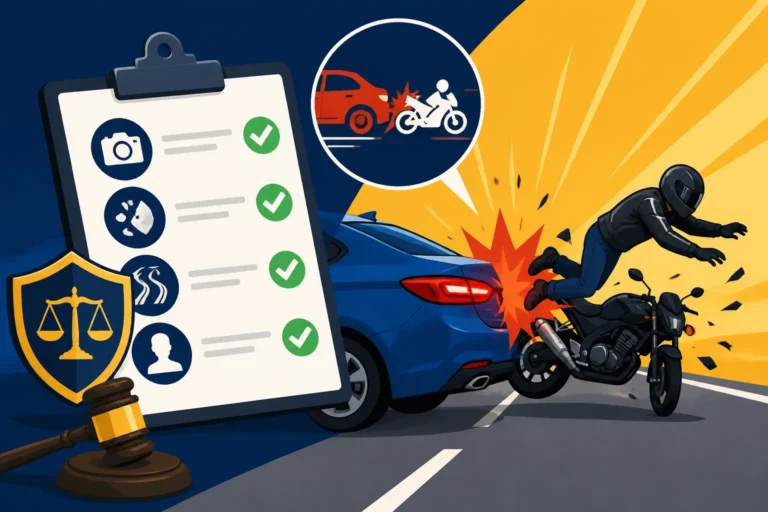
Rear-end collisions are already a frightening prospect for motorcyclists, given our minimal rear protection. When the striking vehicle is speeding, the force of impact dramatically increases, as does the likelihood of severe injury. A speeding driver may simply not perceive a motorcycle ahead of them slowing down or stopping in time, leading to a violent impact. This can happen on highways when traffic suddenly slows, or on city streets where a motorcyclist might be stopping at a red light.
Imagine you're cruising down a busy street in Los Angeles, approaching a congested intersection. You see the light turn yellow and begin to slow down, preparing to stop. A driver behind you, perhaps distracted or simply running late, is going 15-20 mph over the limit. They might not even register your brake light or your smaller profile until it's far too late. The resulting impact can throw a rider clear off their bike, leading to devastating injuries like spinal cord damage, broken bones, or severe road rash. This isn't theoretical; it happens far too often, and the consequences for the rider are almost always more severe than for the person in the car.
Intersection Accidents
Intersections are notorious hotspots for motorcycle accidents, and speeding only amplifies the danger. A speeding driver might run a red light or blow through a stop sign, believing they can "make it" before cross-traffic starts moving. Or, they might misjudge the speed of an oncoming motorcycle when making a turn, leading to a T-bone collision. This is especially prevalent in Motorcycle Accidents Caused by Failure To Yield.
Consider a scenario in Chicago, where a rider is proceeding through a green light at a major intersection. From the cross street, a driver is approaching the intersection at a speed significantly above the limit, perhaps trying to beat a red light. They might not have enough time to brake, or they might make a last-second decision to try and "thread the needle" through the intersection, directly into the path of the unsuspecting motorcyclist. The sheer speed of the car means the rider has almost no chance to react or avoid the impact, often resulting in a direct side impact that can cause catastrophic injuries.
Losing Control
Excessive speed significantly increases the risk of any driver losing control of their vehicle, a risk that is even higher for a motorcyclist. Whether it's taking a curve too fast, encountering unexpected road hazards, or having to make a sudden maneuver, speeding reduces traction, amplifies centrifugal forces, and makes it much harder to regain control once it's lost.
For instance, a driver speeding on a winding rural road in the Appalachian Mountains might enter a sharp curve much too quickly. Their tires lose grip, or they overcorrect, sending their vehicle careening into the opposite lane or off the road. If a motorcyclist is in their path, whether in the oncoming lane or on the shoulder, they become an unwilling participant in a tragic scenario initiated by the speeding driver's reckless behavior. Furthermore, if a rider themselves is speeding and encounters a patch of gravel or uneven pavement – a common occurrence on less-maintained roads – the probability of a Motorcycle Accidents Caused by Road Hazards resulting in a wipeout increases dramatically. Losing control at high speeds often means a rider is separated from their bike, sliding across the pavement, and vulnerable to impact with other vehicles, guardrails, or roadside obstacles.
Legal Implications of Speeding in Motorcycle Crashes
When speeding causes a motorcycle accident, the legal landscape surrounding fault and liability can become complex, especially when dealing with the inherent biases that sometimes affect how motorcyclists are perceived. Understanding how speeding impacts fault determination is crucial for any rider seeking compensation.
How Speeding Affects Fault Determination
In nearly every state, speeding is a traffic violation, and it's generally considered negligent behavior. If a driver is speeding and causes an accident, their speeding is often considered direct evidence of their negligence. This means they are likely to be found at fault for the crash. In a perfect world, this would make assigning blame straightforward. However, the real world of accident claims is rarely so simple.
Insurance companies, especially, are always looking for ways to minimize payouts. Even if the other driver was clearly speeding, they might try to argue that the motorcyclist also contributed to the accident in some way. For instance, they might claim the rider was also speeding, or that the rider was not visible, or that the rider should have reacted differently. This is why thorough evidence collection at the scene is so important. A police report that clearly states the other driver was cited for speeding is a powerful piece of evidence in your favor when determining Who Is at Fault in a Motorcycle Accident.
Traffic Violations and Shared Fault
When a driver's speeding contributes to a motorcycle accident, it automatically puts them in a legally precarious position. A speeding ticket issued at the scene of the accident is strong evidence of negligence and a direct violation of traffic laws. However, it's essential to remember that fault can sometimes be shared, even if one party was speeding. This concept is known as Comparative Negligence in Motorcycle Accidents.
For example, if the car driver was going 20 mph over the limit but the motorcyclist also made an illegal lane change without signaling, both parties might share some percentage of fault. In states that follow modified comparative negligence rules (like Texas or Ohio), if you are found to be 51% or more at fault, you might be barred from recovering any damages. In states with pure comparative negligence (like California or Florida), you can still recover damages, but your award will be reduced by your percentage of fault. This is why it’s so important to accurately determine When a Rider Is Partially at Fault. Even if the other driver was a reckless speed demon, any actions on your part that might be construed as contributing factors could potentially reduce your settlement.
The Impact of "Aggressive Driving"
Speeding often falls under the umbrella of "aggressive driving," which includes behaviors like tailgating, weaving through traffic, and unsafe lane changes. When a driver exhibits a pattern of aggressive driving, coupled with excessive speed, it strengthens the case for their culpability in an accident. Many jurisdictions view aggressive driving more severely than simple speeding, sometimes leading to enhanced penalties and a clearer path to proving fault in a civil claim.
In some extreme cases, particularly those involving exceptionally high speeds or a combination of dangerous maneuvers, the at-fault driver's actions might even cross into gross negligence or willful misconduct. This could open the door for punitive damages, which are designed not to compensate the victim but to punish the egregious behavior of the at-fault party. While rare, proving this level of intent requires significant evidence, which often comes from detailed accident reconstruction, witness statements, and, if available, dashcam footage showing the driver's dangerous behavior leading up to the crash.
Proving Speeding as a Cause in Your Claim
Establishing that the other driver's speeding caused your motorcycle accident is paramount to a successful claim. This isn't always as simple as it sounds; insurance companies will often challenge the extent to which speeding truly contributed or try to shift blame elsewhere. Building a solid case relies on collecting and presenting compelling evidence.
Police Reports and Citations
The police report is often the cornerstone of proving fault in any accident, and it's especially critical when speeding is involved. If the responding officer issues a citation to the other driver for speeding, reckless driving, or any related traffic violation, this is a very strong indicator of their negligence. The officer's professional assessment, based on their investigation at the scene, carries significant weight.
However, it's important to understand that a police report is not always the definitive last word. Sometimes, officers may not issue a citation for speeding if they didn't directly observe it, or if there isn't clear evidence at the scene. This doesn't mean speeding didn't occur. If the report doesn't explicitly mention speeding, but you know the other driver was going too fast, you'll need to rely on other forms of evidence to prove it. Always remember to get a copy of the police report, as it provides a valuable factual foundation for your Motorcycle Accident Evidence for Proving Fault.
Witness Statements and Dashcam Footage
Eyewitness accounts can be incredibly powerful in proving speeding. If a witness saw the other vehicle traveling at an excessive speed before the collision, their statement can corroborate your claim. It’s crucial to gather witness contact information at the scene, even if they only offer a brief comment. Their perception of the other vehicle’s speed, even if not an exact number, can indicate reckless driving.
Furthermore, with the rise of dashcams and helmet cams, video footage has become invaluable. A dashcam from another vehicle or a helmet cam worn by the motorcyclist can provide irrefutable evidence of the other driver's speed and aggressive maneuvers. This kind of footage can not only show the exact moment of impact but also the preceding moments, clearly demonstrating the at-fault driver's excessive speed and disregard for safety. It can be a game-changer when an insurance company tries to deny the other driver was speeding or attempts to assign Rider Bias in Fault Determination.
Accident Reconstruction and Event Data Recorders
When disputes arise regarding speed or impact dynamics, accident reconstruction specialists become indispensable. These experts can analyze various factors such as skid marks, vehicle damage, debris fields, and even witness statements to scientifically determine the speed of the vehicles involved at the time of the collision. They use physics and engineering principles to recreate the accident sequence, offering an objective assessment of how and why the crash occurred.
Many modern vehicles are also equipped with Event Data Recorders (EDRs), often referred to as "black boxes." These devices record crucial data in the moments leading up to and during a crash, including vehicle speed, brake application, throttle position, and seatbelt usage. This data can provide definitive proof of a driver's speed. Accessing EDR data usually requires legal action, but it can be an unassailable piece of evidence in proving How Speeding Affects Motorcycle Accident Fault, particularly in complex or disputed cases.
The Impact on Your Motorcycle Accident Claim
Being involved in a motorcycle accident caused by a speeding driver is a traumatic experience, and navigating the aftermath to secure fair compensation can be incredibly challenging. The other driver's speeding will heavily influence the value and complexity of your claim.
Calculating Damages and Settlement Amounts
When another driver's speeding causes your motorcycle accident, it often leads to more severe injuries and thus higher damages. The faster the impact, the greater the force, and the more extensive the medical treatment required. This directly impacts your economic damages, such as medical bills, lost wages, and property damage to your motorcycle. It also significantly increases your non-economic damages, like pain and suffering, emotional distress, and loss of enjoyment of life.
A strong case proving the other driver's speeding means you have a solid foundation for demanding appropriate compensation. Insurance companies typically assign a higher value to claims where the at-fault party's negligence is clear and egregious, like excessive speeding. For instance, if you suffered a broken leg in a crash caused by a speeding driver, your claim could include not only the immediate costs of emergency care and surgery but also ongoing physical therapy, lost income during recovery, and compensation for the significant pain and disruption to your life. Understanding how Average Motorcycle Accident Settlement Amounts are calculated helps set realistic expectations.
| Type of Damage | How Speeding Impacts It | Examples |
|---|---|---|
| Medical Expenses | Higher speeds lead to more severe injuries, requiring extensive treatment. | Emergency room visits, surgeries, specialist consultations, medications, physical therapy. |
| Lost Wages | More severe injuries mean longer recovery times and more missed work. | Current and future income loss, reduced earning capacity due to permanent injury. |
| Property Damage | Higher impact force often results in total loss of motorcycle and gear. | Cost to repair or replace motorcycle, helmet, leathers, gloves, boots. |
| Pain and Suffering | Catastrophic injuries from high-speed impacts cause immense physical and emotional distress. | Chronic pain, emotional trauma, PTSD, disfigurement, loss of enjoyment of life. |
Dealing with Insurance Company Tactics
Even with clear evidence of the other driver's speeding, insurance companies are in the business of minimizing payouts. They might still employ various tactics to reduce your settlement or shift some blame onto you. They might argue that your motorcycle itself contributed to the crash due to its smaller size, or that you could have avoided the accident if you had been more vigilant. They might even try to suggest you were also speeding, especially if there's no definitive proof of your speed at the time. This is where the unfortunate reality of How Insurance Companies Assign Blame to Riders comes into play.
They might offer a lowball settlement early on, hoping you'll accept it before fully understanding the extent of your injuries and damages. It's crucial to be wary of these tactics and not to admit fault or sign anything without consulting an experienced professional. Document everything, from your injuries to conversations with adjusters. Having a clear narrative backed by evidence about the other driver's speeding puts you in a much stronger position to counter these tactics.
Maximizing Your Claim
To truly maximize your motorcycle accident settlement when speeding is involved, you need to be proactive and strategic from the very beginning. After ensuring your safety and seeking medical attention, documenting everything at the scene is critical. Take photos of both vehicles, the road conditions, any skid marks, and anything that indicates speed or impact force. This documentation strengthens your claim and helps counter any attempts by the insurance company to downplay the severity or dispute the cause.
Furthermore, promptly seeking medical treatment and diligently following all prescribed care plans is paramount. Gaps in treatment can be used by insurance companies to argue that your injuries aren't as severe as you claim or weren't caused by the accident. Maintaining a detailed record of all medical appointments, bills, and how your injuries affect your daily life will provide irrefutable evidence of your damages. While this article focuses on the immediate aftermath, knowing What to Do After a Motorcycle Accident can make a significant difference to your ability to secure compensation later. Ultimately, having a strong case built on concrete evidence of the other driver's speeding will greatly enhance your ability to receive the compensation you deserve for your injuries and losses.
Disclaimer
Please remember, this information is for educational purposes only and should not be taken as legal advice. Every motorcycle accident claim is unique, and the laws governing personal injury vary significantly by state. If you've been involved in a motorcycle accident, it's always best to consult with a qualified legal professional to discuss the specifics of your situation.