How Dashcam Footage Proves Fault
When you're out on two wheels, the road can sometimes feel like a battlefield, especially when another driver makes a critical error. The common lament, "I didn't even see the motorcycle," is a phrase that strikes fear into every rider, often leading to unfair blame or disputed liability in the aftermath of an accident. This guide is here to shed light on how modern technology, specifically dashcam footage, can be an absolute game-changer, transforming contested claims into clear-cut cases and ensuring you get the justice you deserve after a motorcycle accident.
The Undeniable Power of Dashcam Footage in Motorcycle Claims
Let's be honest: motorcyclists often face an uphill battle when proving fault after a crash. There's an unfortunate, ingrained bias that often assumes the rider was somehow at fault, or at least contributed to the collision, simply because they were on a motorcycle. This bias can permeate everything from initial police reports to insurance company investigations. That's where objective evidence becomes not just helpful, but absolutely critical, and nothing offers objective clarity quite like a dashcam.
Why Traditional Evidence Falls Short for Riders
In a typical motorcycle accident scenario, especially one involving a car or truck, the evidence often boils down to a few key pieces: witness statements, the police report, and the testimonies of the drivers involved. While these are important, they are inherently flawed and often work against the rider.
Witnesses, bless their hearts, often have good intentions, but their recollections can be hazy, biased, or incomplete. They might have only seen a fleeting moment of the crash, or they might have their own preconceptions about motorcycles. We've all heard stories of witnesses who "saw the motorcycle speeding" when it was simply moving at the posted limit, or who missed the car's critical error entirely. Police reports, while official, are often based on these same potentially flawed witness accounts and the immediate, sometimes chaotic, impressions at the scene. An officer arriving after the fact can only document what they see and hear, not what actually transpired in the moments leading up to the impact. This often leads to a frustrating "he said, she said" situation, leaving the rider feeling unheard and unfairly judged.
How Dashcams Level the Playing Field
This is precisely where dashcam footage steps in as a powerful equalizer. Imagine having a silent, unbiased observer recording every second of your ride. A dashcam doesn't have preconceived notions about motorcyclists, doesn't get flustered, and doesn't forget details. It simply records the raw, unadulterated truth.
By capturing real-time events, dashcam footage can decisively counter false narratives, correct inaccurate witness statements, and provide irrefutable proof of how the accident unfolded. For riders, who are often statistically more vulnerable and unfairly blamed in accidents, this technology can literally change the trajectory of their claim. It transforms a subjective argument into an objective presentation of facts, making it incredibly difficult for insurance companies or opposing counsel to deny liability or assign unfair blame. This objective evidence is paramount when it comes to Proving Fault in a Motorcycle Accident.
Types of Dashcam Footage and What They Capture
Dashcam technology for motorcycles has come a long way, offering various setups to give riders comprehensive coverage. Understanding the different types available and what they typically record is key to appreciating their value in an accident claim. It's not just about having a camera; it's about having the right camera in the right place to capture the most pertinent information.
Front-Facing Motorcycle Dashcams
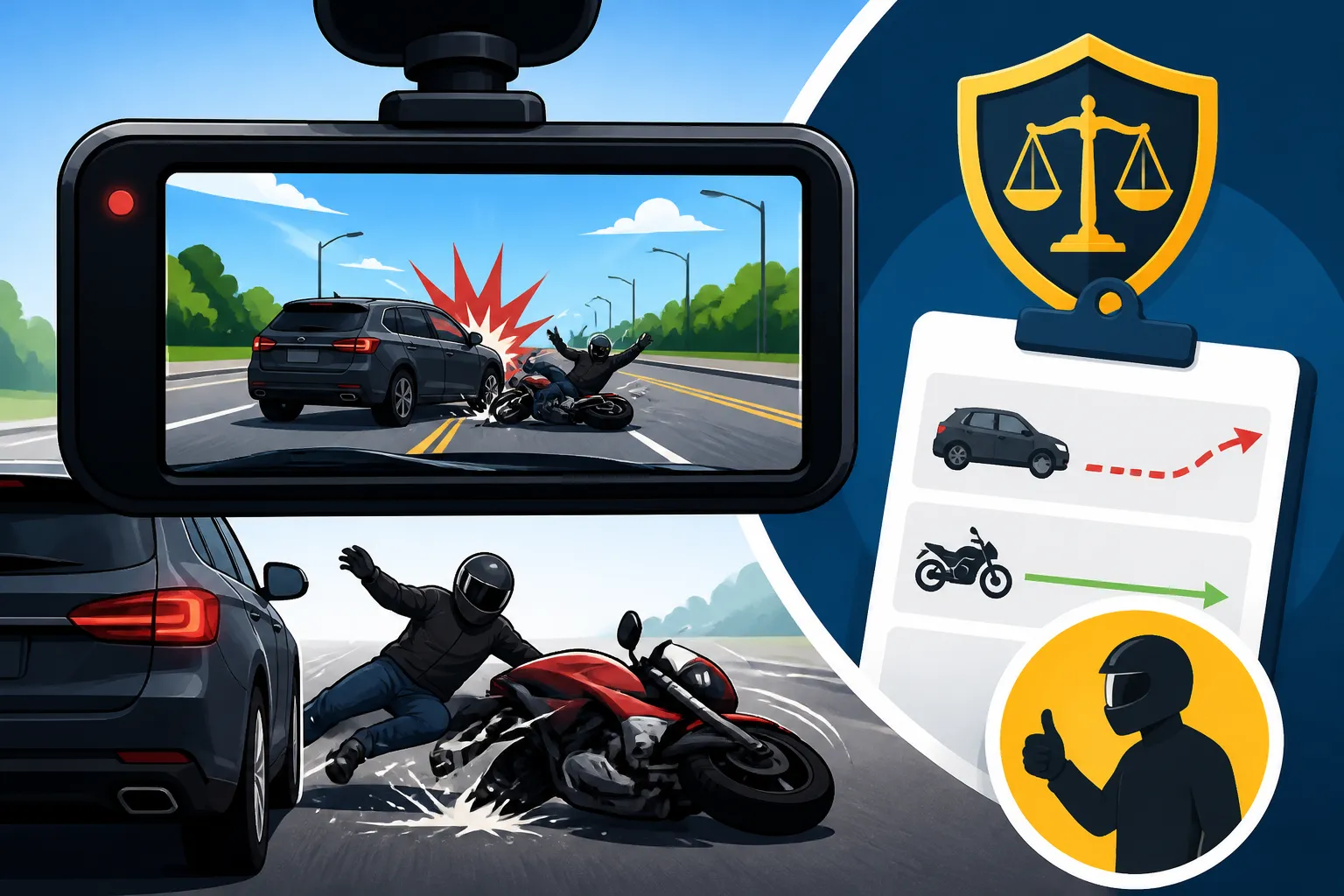
The most common and arguably essential type is the front-facing dashcam. Mounted prominently on your helmet or motorcycle's fairing, these cameras primarily capture what's directly ahead of you. This perspective is crucial for documenting a wide array of potential accident scenarios and driver negligence.
A good front-facing camera will record the actions of other drivers, such as sudden lane changes, running red lights, failure to yield, or aggressive maneuvers that lead to a collision. It captures the traffic flow, road conditions, and environmental factors like glare or obstructions. Most importantly, it clearly shows the path you were taking and the actions of the vehicle that collided with you, often from the "rider's eye" perspective. This footage can be indispensable in demonstrating that you were riding safely and defensively, and that the other driver's actions were the direct cause of the incident.
Rear-Facing and Multi-Camera Systems
While a front-facing camera is vital, adding a rear-facing camera or investing in a multi-camera system significantly enhances your evidentiary capabilities. Accidents don't always happen from the front; rear-end collisions are unfortunately common and can be devastating for riders.
A rear-facing camera, typically mounted on the tail section, records what's happening behind you. This is invaluable for proving cases involving Motorcycle Accidents Caused by Rear-End Collisions, tailgating, sudden braking by a following vehicle, or even road rage incidents where a driver was aggressively pursuing you. Many advanced motorcycle dashcam systems, like those offered by companies such as Innovv or Sena, come with both front and rear cameras, often integrated with GPS for speed and location data. Some even offer side-view cameras, creating an almost 360-degree record of your journey. This comprehensive view ensures that no matter where an impact comes from, you have objective footage to back up your account and demonstrate the circumstances leading to the crash.
Car Dashcams and Third-Party Footage
It's important to remember that not all valuable dashcam footage comes from your motorcycle. Many cars are now equipped with dashcams, and businesses often have security cameras recording public areas. This third-party footage can be just as, if not more, critical than your own, especially if your camera failed or didn't capture a key angle.
After an accident, it’s always wise to ask around if anyone else witnessed the crash and if they happened to have a dashcam. Businesses near the accident scene, particularly those with parking lots or storefronts facing the street, might have surveillance footage that captured the incident. Public cameras, like those at traffic intersections in cities like San Francisco or Chicago, are also potential sources. Identifying and securing this external footage quickly is paramount because many systems have limited storage and automatically overwrite old recordings. This collective evidence paints a fuller picture, reinforcing your claim and adding layers of verifiable detail.
How Dashcam Footage Specifically Proves Fault
The beauty of dashcam footage lies in its ability to transform abstract claims into concrete facts. It doesn't just show an accident; it often reveals the critical moments of negligence that lead to it, leaving little room for doubt or misinterpretation. When trying to establish Who Is at Fault in a Motorcycle Accident, this objective evidence can make all the difference.
Documenting Driver Negligence
Perhaps the most impactful way dashcam footage proves fault is by directly documenting the negligent actions of the other driver. It’s hard to deny what’s caught on camera.
For instance, if a driver was swerving erratically or drifted into your lane, the footage clearly shows their unsafe movement. If the other driver claims they had a green light, but your dashcam records them blowing through a red, their testimony crumbles. This is especially vital in cases involving Motorcycle Accidents Caused by Distracted Driving, where a driver might claim they were paying attention, but the video reveals them looking down at their phone just moments before the crash. Footage can capture specific details, like a driver signaling incorrectly, failing to check their blind spots before changing lanes, or even engaging in aggressive behaviors that initiated the incident. These visual records provide undeniable proof of their violation of traffic laws and duty of care, directly establishing their culpability.
Contradicting False Driver Testimonies
One of the most frustrating aspects of motorcycle accident claims is when the other driver provides a false or misleading account of the events. This is particularly common with the infamous "I didn't see the motorcycle" defense, which is often a thinly veiled admission of inattention, but can be spun to suggest the rider appeared out of nowhere.
Dashcam footage effectively obliterates these fabrications. If a driver claims you were speeding, but your video, especially if it includes GPS data, shows you were well within the speed limit, their claim becomes baseless. If they say you cut them off, but the footage shows you maintaining your lane and them veering into you, the truth is undeniable. This objective record counters their subjective, often self-serving, testimony, forcing them to confront the reality of their actions. It protects you from the unfortunate Rider Bias in Fault Determination that insurance companies and juries sometimes harbor, offering a factual counter-narrative to dispel stereotypes.
Establishing Crucial Timelines and Sequences
Accident reconstruction often relies on precise timing and sequence of events. Eyewitnesses and even the drivers themselves can have jumbled recollections, especially in the adrenaline-fueled aftermath of a crash. Dashcam footage eliminates this guesswork by providing a clear, synchronized timeline.
The video shows the exact moment a vehicle began its turn, when a signal was (or wasn't) used, the precise point of impact, and the trajectory of both vehicles post-collision. This detailed sequence can be crucial in cases where multiple factors are at play, or where the speed and movement of vehicles are disputed. For example, in a complex intersection accident, the footage can pinpoint which vehicle entered the intersection on a stale yellow or red light, or which driver initiated an unsafe maneuver. This verifiable timeline allows accident reconstructionists and legal professionals to accurately assess fault, leaving little to speculation.
Maximizing the Evidentiary Value of Your Dashcam Footage
Having dashcam footage is a significant advantage, but merely possessing it isn't enough. You need to know how to properly secure, preserve, and present it to ensure it serves its purpose in your motorcycle accident claim. Mishandling this crucial evidence can inadvertently weaken your case.
Securing and Preserving the Footage Immediately
The moments after an accident are chaotic, but if you have a dashcam, your first priority (after ensuring your safety and calling for emergency services) should be to secure that footage. Most dashcams operate on a loop recording system, meaning older footage is automatically overwritten once the memory card is full.
Immediately after an incident, remove the memory card from your dashcam. If your camera has a "lock" or "event" button, press it to save the current segment. As soon as you can, transfer the footage to a more permanent storage solution, such as a computer, external hard drive, or cloud storage. Make multiple copies. Do not, under any circumstances, reformat the card or continue to use it for new recordings until the relevant footage is safely backed up. Even if the footage seems minor, preserve it. You never know what detail might become critical later. This proactive step ensures that this invaluable piece of evidence is not lost forever, strengthening your position when dealing with insurance adjusters or preparing for litigation.
Presenting Footage to Authorities and Insurers
Knowing when and how to present your dashcam footage can be strategic. While it might be tempting to immediately show it to the police officer at the scene, sometimes it's better to consult with legal counsel first.
When law enforcement arrives, you should certainly inform them that you have dashcam footage. They may ask to see it, or they might instruct you to provide it later. Cooperate, but understand that your primary goal is to report the facts, not make admissions. If you have any doubts about what the footage shows or how it might be interpreted, it's always safer to say, "I have footage, and I'll provide it to the investigating officer or my attorney." Similarly, when dealing with insurance companies, especially the at-fault driver's insurer, be cautious. Provide the footage to your own attorney first. They can then present it strategically as part of your overall evidence package, ensuring it is used to your maximum advantage without accidentally giving the insurer an angle to dispute it. Remember, insurers are looking to minimize payouts, and how they How Insurance Companies Assign Blame to Riders can be heavily influenced by how evidence is presented.
Professional Analysis and Enhancement
In some complex cases, raw dashcam footage might benefit from professional analysis and enhancement. This is especially true if the lighting was poor, the image is blurry, or if specific details need to be highlighted for clarity in court.
Accident reconstruction experts or forensic video analysts can enhance the footage, stabilize shaky images, zoom in on critical elements like a license plate or a driver's actions, and even sync it with other data like GPS logs or police reports. They can create compelling visual presentations that clearly illustrate fault to a jury or arbitrator. For example, if your footage captures a road hazard that caused your crash, an expert can definitively prove how that hazard led to your loss of control. This level of professional interpretation can transform good evidence into undeniable proof, making your case significantly stronger and providing leverage in negotiations for your Motorcycle Accident Settlement Process Explained.
Common Scenarios Where Dashcam Footage is a Game-Changer
While dashcam footage is beneficial in nearly any accident scenario, there are specific types of motorcycle crashes where its impact can be particularly profound, often turning a hotly contested dispute into a straightforward admission of fault.
Left-Turn Collisions and Failure to Yield
Ah, the dreaded left-turn collision. This is, sadly, one of the most frequent and dangerous types of motorcycle accidents. A car driver making a left turn often fails to see an oncoming motorcycle, misjudges its speed, or simply doesn't yield the right-of-way. The driver will almost always claim they "didn't see" the motorcycle or that the motorcycle "came out of nowhere."
Dashcam footage obliterates these defenses. Your front-facing camera will clearly show your motorcycle approaching the intersection, its speed, and the signal status. It will then capture the other driver initiating their left turn directly into your path, violating your right-of-way. This undeniable visual evidence proves their Left-Turn Motorcycle Accidents Explained negligence beyond a shadow of a doubt, making it incredibly difficult for their insurance company to deny liability. It removes any subjective interpretation and presents the objective truth of the event.
Lane Splitting Accidents
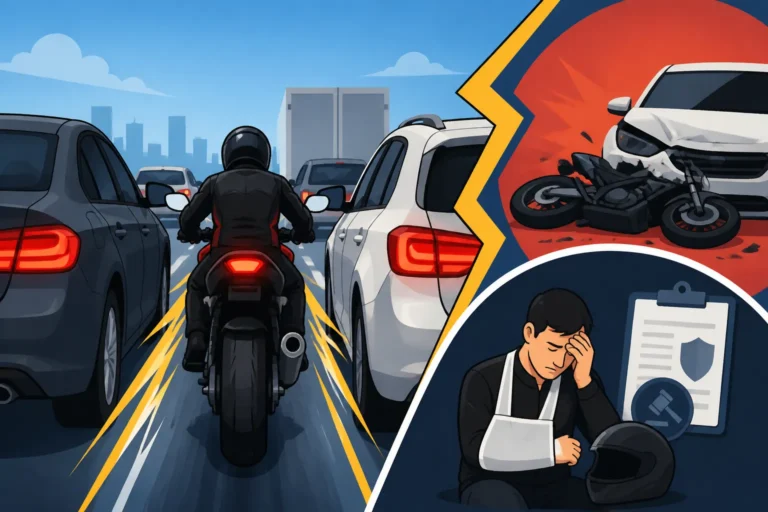
Lane splitting, while legal in some states like California, remains a contentious issue and is often misunderstood by other drivers. When an accident occurs while a rider is lane splitting, drivers are quick to blame the motorcyclist, even if the driver themselves made an unsafe lane change.
Here, dashcam footage becomes critical. It can clearly show if the rider was performing a legal lane split, adhering to speed limits relative to traffic flow, and riding responsibly. More importantly, it can capture the car driver's actions – a sudden, unsignaled lane change, opening a door without looking (a "dooring" accident), or aggressive maneuvering into the rider's path. Without footage, the rider might face unfair accusations. With it, you have a clear record showing that the other driver's actions, not the lane split itself, were the proximate cause of the collision, as discussed in detail in Lane Splitting and Motorcycle Accident Liability.
Rear-End Collisions
Rear-end collisions might seem straightforward, with the trailing driver typically at fault. However, when a motorcycle is involved, the other driver might attempt to shift blame by claiming the motorcyclist braked suddenly, cut them off, or was riding erratically.
A rear-facing dashcam provides irrefutable proof in these situations. It shows the following vehicle's distance, speed, and approach. It can confirm if they were tailgating, distracted, or simply not paying attention. If you were indeed struck from behind, the footage will clearly demonstrate that your braking was a normal response to traffic conditions, or that you were stationary, and the other driver failed to stop. This evidence safeguards you from attempts to assign Shared Fault in Motorcycle Accidents unfairly, ensuring the true at-fault party is held accountable. This footage also provides crucial evidence regarding Motorcycle Accidents Caused by Rear-End Collisions.
Road Hazard Accidents and Third-Party Liability
Sometimes, an accident isn't directly caused by another driver, but by a dangerous road condition – a massive pothole, loose gravel, an unmarked construction zone, or unexpected debris. In these cases, proving fault involves demonstrating the existence of the hazard and that the responsible party (often a municipality or construction company) failed to address it.
Your dashcam footage can be invaluable here. It captures the specific road hazard, its location, and how it directly contributed to your accident. This visual proof documents the hazard's existence and condition before your crash, making it harder for responsible parties to deny knowledge or claim the hazard was minor. For instance, if you hit a large, unmarked pothole that caused you to lose control, the footage can show the pothole clearly, your reasonable speed, and the unavoidable nature of the impact. This helps establish Government Liability for Road Hazards or the liability of other entities responsible for maintaining safe road conditions, proving the specific type of Motorcycle Accidents Caused by Road Hazards.
Legal Implications and Challenges
While dashcam footage is a powerful tool, understanding its legal implications and how it interacts with various legal principles is crucial. It's not a magic bullet, but it significantly tips the scales in your favor when navigated correctly.
How Footage Impacts Comparative Negligence
Most states in the U.S. operate under some form of comparative negligence. This means that if you are found partially at fault for an accident, your compensation can be reduced by your percentage of fault. For example, if you are 20% at fault, your total settlement might be reduced by 20%. The exact rules vary by state, with some states following "pure" comparative negligence (like California), and others "modified" (like Texas or Ohio).
Dashcam footage can be instrumental in minimizing your assigned percentage of fault, even if there's an argument you contributed slightly. If the footage clearly shows the other driver committed the primary negligent act, it becomes very difficult for an insurance company or a jury to assign a high percentage of blame to you. For example, if a car makes an illegal left turn in front of you, but an argument is made that you were going slightly over the speed limit, the footage can still emphasize the driver's egregious error, potentially reducing your comparative fault from, say, 30% down to 10% or less. This directly impacts your net payout, as detailed in Comparative Negligence in Motorcycle Accidents and How Comparative Negligence Reduces Your Payout.
Overcoming Rider Bias with Objective Evidence
As previously mentioned, motorcyclists often face an inherent bias. Juries, police officers, and even insurance adjusters might subconsciously assume that riders are inherently risk-takers or that they somehow contributed to their own accidents. This "rider bias" can lead to unfair fault assignments or lower settlement offers.
Dashcam footage directly combats this bias by presenting objective, undeniable facts. It shows your careful riding, adherence to traffic laws, and the sudden, unexpected actions of the other driver. When a jury or adjuster sees the reality of the situation through a camera lens, it becomes much harder for them to rely on stereotypes. The footage humanizes the rider's experience and showcases the events as they truly unfolded, moving the focus from "motorcyclist" to "victim of negligence." This direct evidence is a powerful counter-narrative against the often-unspoken biases that can impact Rider Bias in Fault Determination.
Footage as Leverage in Settlement Negotiations
Perhaps one of the most practical benefits of dashcam footage is its power as leverage in settlement negotiations. Insurance companies thrive on ambiguity and dispute. When fault is clear, their ability to dispute liability diminishes significantly.
With clear dashcam footage, you hold a strong hand. The insurance company knows that if the case goes to court, that video will be played for a jury. This dramatically increases their incentive to settle fairly out of court, rather than risk a larger judgment. It reduces the time and expense of protracted legal battles and often leads to a higher, faster settlement. The footage acts as a powerful deterrent against lowball offers and aggressive defense tactics, ensuring that How Fault Affects Your Settlement is determined fairly based on the evidence, not on conjecture or bias.
Here’s a quick overview of how different types of evidence stack up in proving fault:
| Type of Evidence | Strengths | Weaknesses | Impact on Proving Fault |
|---|---|---|---|
| Dashcam Footage | Objective, real-time, undeniable, captures sequence & negligence | Can be limited by camera angle/quality, rider might not have one | Extremely High |
| Witness Statements | Can corroborate events, independent perspective | Subjective, prone to error/bias, memory fades, hard to locate | Moderate to High |
| Police Report | Official record, documents scene, initial findings | Based on initial impressions/statements, can be biased/incomplete | Moderate |
| Driver Testimony | Direct account from involved party | Highly subjective, self-serving, prone to dishonesty | Low to Moderate |
| Photos/Videos | Documents scene, damage, injuries (after the fact) | Doesn't show how accident happened, can be selectively taken | Moderate |
| Accident Sketch | Visual representation of scene | Interpretive, based on statements, not actual event | Low |
| Vehicle Damage | Confirms point of impact, force | Doesn't show pre-impact events or fault | Low to Moderate |
This table clearly illustrates why dashcam footage stands out as the most powerful and objective form of evidence in proving fault in a motorcycle accident claim.
Disclaimer
Please remember that this article provides general information and is not legal advice. Every motorcycle accident claim is unique, and the information presented here may not apply to your specific situation. Laws regarding fault, negligence, and evidence vary significantly by state and jurisdiction. It is always recommended to consult with a qualified legal professional to discuss the specifics of your case and understand your rights and options.