Proving Fault in a Motorcycle Accident
Riding a motorcycle offers unparalleled freedom, but it also comes with unique challenges, especially when an accident happens. One of the toughest hurdles riders face isn't just the physical recovery, but the often-frustrating process of proving fault. Many times, despite being the victim, motorcyclists are unfairly blamed or stereotyped, making it an uphill battle to get the justice and compensation they deserve. This comprehensive guide is here to equip you with the knowledge and strategies you need to effectively gather evidence, understand liability, and build an undeniable case to prove fault in a motorcycle accident.
The Unique Challenges of Proving Fault in Motorcycle Accidents
Let's be real: as motorcyclists, we often feel like we're fighting an uphill battle, especially after a crash. There's a persistent, unfair bias that exists, and it's something you need to be acutely aware of when you're trying to prove fault in an accident. It's not just about the facts; it's about perception, and that can significantly complicate your claim.
Overcoming Rider Bias and Stereotypes
It’s an unfortunate reality, but in many situations, there's an immediate, unspoken assumption that a motorcyclist must have been doing something reckless or dangerous to be involved in a crash. You see it in the casual comments, in the way some onlookers might react, and most definitely, in the tactics insurance companies often employ. They'll subtly (or not-so-subtly) try to paint a picture of you as an adrenaline junkie, implying your injuries are a natural consequence of a risky lifestyle, rather than the result of someone else's negligence. This "rider bias" can be incredibly frustrating, and it directly impacts how fault is perceived.
Imagine this scenario: you're riding responsibly down a suburban street, well within the speed limit, and a car suddenly pulls out from a driveway without looking. You hit the brakes, but it's too late. When the police arrive, or when you later speak to an insurance adjuster, you might find yourself answering questions about your speed, your gear, or whether you were "showing off," even when those factors had absolutely nothing to do with the other driver's clear failure to yield. This subtle, pervasive bias means that even with clear evidence, you might need to work harder to ensure your narrative of responsible riding is heard and accepted. This is precisely why understanding and countering Rider Bias in Fault Determination is so crucial from the very beginning.
The 'I Didn't See the Motorcycle' Defense
This is perhaps one of the most maddening phrases any motorcyclist can hear after a crash. "I just didn't see you!" It's uttered by drivers, repeated by witnesses, and used by insurance adjusters as if it somehow absolves the driver of responsibility. But here’s the cold, hard truth: "I didn't see the motorcycle" is not a valid legal defense for causing an accident. Drivers have a fundamental duty to operate their vehicles safely and to look out for all other road users, including motorcycles.
Think about it: many modern cars are practically rolling living rooms, filled with distractions from infotainment systems to smartphones. Drivers might be chatting with passengers, adjusting the radio, or simply lost in thought. When they fail to perform a proper visual scan—checking mirrors, turning their heads—they create dangerous situations for motorcyclists, who are already smaller and less conspicuous than other vehicles. This defense often highlights driver inattention, a common cause of accidents, rather than any fault on the rider's part. It points to a failure of perception, judgment, and ultimately, a failure of their legal duty. When this defense is inevitably raised, understanding The 'I Didn't See the Motorcycle' Defense Explained and how to dismantle it with solid evidence is paramount to your case.
The Severity of Motorcycle Injuries as a Double-Edged Sword
We all know the stark reality: a motorcycle offers minimal protection compared to a car. When a crash happens, the rider bears the brunt of the impact, often resulting in severe and life-altering injuries. While these extensive injuries are undeniable proof of the accident's impact and are a major component of your claim, they can also paradoxically create challenges in the immediate aftermath.
On one hand, significant injuries like a traumatic brain injury, spinal cord damage, or severe road rash clearly demonstrate the devastating consequences of the collision, often leading to higher compensation for medical bills, lost wages, and pain and suffering. On the other hand, the very nature of these injuries means you, as the rider, might be incapacitated or rushed to the hospital, unable to gather crucial evidence at the scene. You might be in too much pain, too disoriented, or even unconscious. This immediate inability to document the scene, speak to witnesses, or collect driver information can leave vital pieces of evidence unrecorded, which can later be exploited by the opposing party. This is why, even if you're seriously hurt, instructing someone you trust or relying on law enforcement to collect initial evidence is critical. The list of Common Motorcycle Accident Injuries is long and severe, underscoring the importance of swift action, even if it's taken by others on your behalf.
Key Evidence to Gather at the Accident Scene
The moments immediately following a motorcycle accident are chaotic, painful, and often confusing. However, what you (or someone acting on your behalf) do during this critical window can make or break your ability to prove fault. Every piece of information, no matter how small it seems at the time, can be a crucial puzzle piece in establishing exactly what happened and who was responsible.
Documenting the Scene with Photos and Videos
In today's world, almost everyone carries a powerful camera in their pocket. If you are physically able, or if a passenger or a good Samaritan can help, use your smartphone to document everything. And when I say everything, I mean everything. Don't just snap one or two blurry photos; get a comprehensive visual record.
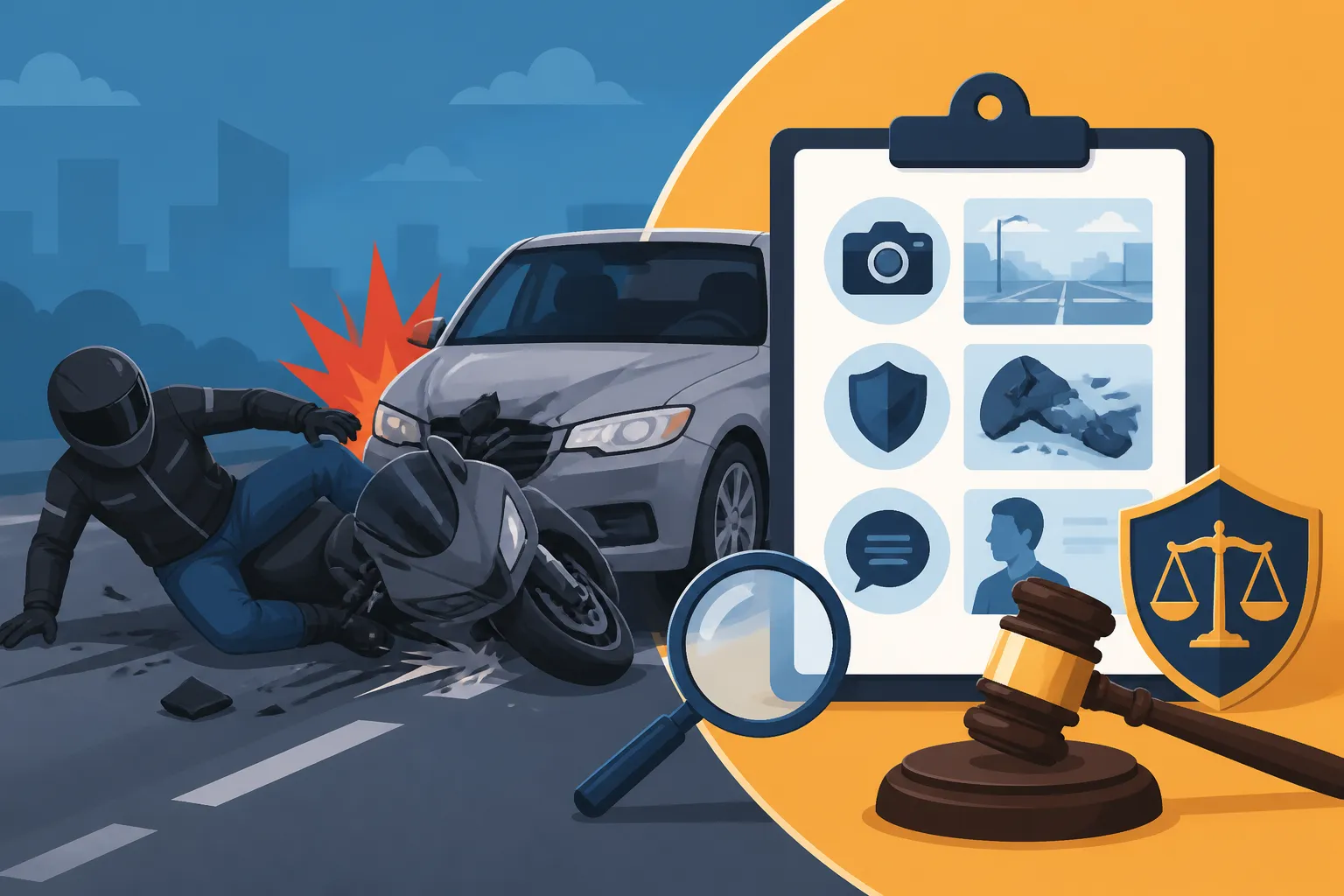
Start by capturing wide shots that show the overall scene, including road conditions, traffic signals, and any relevant signage. Then, move in for close-ups. Photograph the damage to both your motorcycle and the other vehicle from multiple angles. Look for points of impact, dents, scratches, and any paint transfer. Don't forget to photograph debris scattered on the road, such as broken glass, plastic, or fluids. These can indicate the point of impact and the direction of travel. Skid marks, tire marks, and even scuff marks on the road surface are incredibly important; photograph them with a ruler or common object (like a shoe) for scale, and make sure to show their length and trajectory. Capture the positions of the vehicles before they are moved, if possible. If the weather played a role, take photos of rain, snow, or fog. Remember, Photos to Take to Prove Motorcycle Fault are not just visual aids; they are factual records that can speak volumes to investigators and insurance adjusters alike, helping to counter any conflicting narratives.
Collecting Driver and Witness Information
Once you've ensured everyone's immediate safety and called 911, the next step is to gather contact and insurance information from everyone involved. This is non-negotiable. Get the other driver's full name, address, phone number, driver's license number, vehicle make and model, license plate number, and insurance company details, including policy number. If they hesitate or refuse, make sure the police are aware and document it in their report.
Equally important, and often overlooked, is collecting information from any witnesses. People might offer help, or just be standing by observing. Don't let them just walk away without getting their contact details. Ask for their name, phone number, and email. Even a brief statement from them at the scene can be incredibly valuable. Ask them what they saw, what direction vehicles were traveling, and if they noticed anything specific about the other driver (e.g., distracted, speeding). Independent witnesses, those not involved in the crash, can provide objective accounts that carry significant weight in proving fault. Their testimony can often validate your account against a biased opposition. For more on this, understand How Witnesses Affect Motorcycle Fault.
Preserving Your Motorcycle and Gear
After the shock of a crash, your first instinct might be to get your bike fixed or discard your damaged gear. Resist that urge! Your damaged motorcycle and riding gear are critical pieces of evidence. Your motorcycle, with its dents, scratches, and structural damage, tells a story about the force and direction of the impact. Do not have your bike repaired before it has been thoroughly inspected and photographed by investigators or your legal team. If it's moved from the scene, ensure it's taken to a secure location where it can be properly examined.
Similarly, your riding gear—your helmet, jacket, pants, and boots—can show crucial impact points. A cracked helmet, scuffed jacket, or torn pants can not only demonstrate the severity of the accident but also corroborate your account of how the crash occurred. For example, specific scuff marks on your left shoulder and hip could indicate a slide-out to the left. These items are tangible proof of what you endured and how you were impacted. Preserving them helps substantiate your injuries and the dynamics of the collision. It's a key aspect of showing How Gear Damage Supports Your Claim and should be handled with care.
Understanding Different Types of Motorcycle Accidents and Fault
Motorcycle accidents aren't all the same, and the way fault is assigned can vary significantly depending on the circumstances of the collision. Understanding these common accident types helps riders anticipate potential defenses and proactively gather the right evidence to demonstrate the other party's negligence.
Left-Turn Collisions
This is, tragically, one of the most common and often devastating types of motorcycle accidents. You're riding straight through an intersection or down a road, and an oncoming car suddenly makes a left turn directly into your path. The driver often claims they "didn't see" the motorcycle, but legally, the responsibility almost always falls on the turning driver. They have a duty to yield the right-of-way to oncoming traffic, including motorcycles, before initiating a turn.
These accidents are particularly dangerous for motorcyclists because they often result in head-on or T-bone impacts, which can be catastrophic. The suddenness leaves little to no time for the rider to react, brake, or swerve, making serious injuries almost inevitable. Proving fault in these cases often involves establishing that the driver failed to yield, which can be supported by witness statements, traffic camera footage, or even the damage patterns on both vehicles. For a deeper dive into this specific scenario, check out Left-Turn Motorcycle Accidents Explained and learn How to Prove Fault in a Left-Turn Collisions Crash.
Rear-End Collisions
While less common for motorcycles than for cars, rear-end collisions still happen, and they can be just as dangerous. In almost all rear-end accidents, the trailing driver is considered at fault. This is because drivers are expected to maintain a safe following distance, allowing them sufficient time and space to react to sudden stops or changes in traffic flow ahead.
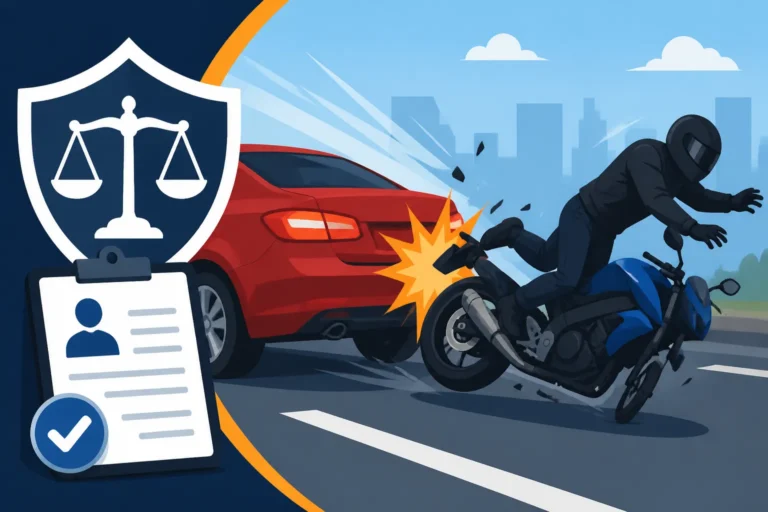
A typical scenario might involve you stopping at a red light or slowing for traffic, only for the car behind you to fail to brake in time, slamming into your rear. The impact can launch a rider forward, leading to severe road rash, spinal injuries, or even being thrown into oncoming traffic. Even if you made a sudden stop, if the driver behind you was following too closely, their negligence is usually the primary factor. Evidence here often includes the extent of damage to the rear of your bike and the front of their vehicle, skid marks (or lack thereof from the trailing vehicle), and witness statements confirming the driver was distracted or tailgating. Understanding Motorcycle Accidents Caused by Rear-End Collisions is essential for protecting your rights in such situations.
Road Hazards and Government Liability
Not all accidents are caused by another driver's direct actions. Sometimes, the road itself is a hazard, and in these cases, fault might lie with the entity responsible for road maintenance. Potholes, cracks, uneven pavement, gravel, sand, oil spills, or poorly marked construction zones can all create extremely dangerous conditions for motorcyclists, who are far more susceptible to losing control due to such obstacles than cars.
Imagine hitting a massive pothole that appears out of nowhere, causing you to lose control and crash. Or perhaps fresh gravel from a poorly maintained shoulder spills onto your lane, leading to a slide-out. In such instances, the local, state, or even federal government agency responsible for maintaining that particular stretch of road could be liable. However, proving government liability is often complex. You'll need to demonstrate that the hazard existed, the government agency knew or should have known about it, failed to fix it or warn adequately, and this failure directly caused your accident. Documentation of the hazard, photos of its size and location, and records of previous complaints or repair orders can be crucial. This can be a challenging path, so delving into Road Hazards Motorcycle Accidents and Government Liability for Road Hazards can provide valuable insights.
How Police Reports and Official Investigations Impact Fault
When a motorcycle accident happens, the first official step beyond immediate medical care is typically law enforcement involvement. The police report generated at the scene, along with any subsequent official investigations, plays a significant role in establishing the initial narrative of fault. However, it's crucial to understand both the weight and the limitations of these documents.
The Role of the Police Report
A police report is often the first formal document that outlines the details of an accident. It typically includes:
- Date, time, and location of the accident.
- Identification of all parties involved (drivers, passengers, witnesses).
- Vehicle information (make, model, license plate, VIN).
- Insurance information.
- Diagram of the accident scene.
- Officer's narrative describing how the accident occurred, often based on initial observations, witness statements, and driver statements.
- Citations issued, if any.
- Officer's opinion on fault, in many cases.
While police reports are often relied upon by insurance companies as a primary source of information, it’s important to remember that they are based on a snapshot in time, often compiled under stressful conditions, and can sometimes contain inaccuracies or incomplete information. The officer might not have witnessed the crash, and their opinion on fault isn't always legally binding, though it carries significant weight. For instance, if an officer issues a citation to the other driver for failing to yield, that's powerful evidence. Conversely, if you receive a citation, it could be used against you. Understanding How Police Reports Establish Fault is vital, but equally important is knowing How to Correct a Wrong Police Report if it contains errors. If you notice inaccuracies, especially regarding your actions or the crash dynamics, you might be able to submit an addendum or challenge the report's findings.
Accident Reconstruction Experts
Sometimes, the circumstances of an accident are simply too complex or disputed for a basic police report to adequately determine fault. This is where accident reconstruction experts become invaluable. These highly specialized professionals use scientific principles, physics, and engineering to meticulously recreate the accident scene and determine the sequence of events leading up to and during the collision.
They might analyze a wide array of evidence, including:
- Vehicle damage: Assessing the type, location, and severity of damage on all vehicles involved.
- Skid marks and tire marks: Analyzing length, direction, and type to calculate speed, braking points, and impact angles.
- Debris patterns: Mapping the location of scattered vehicle parts, glass, and fluids to pinpoint the exact point of impact.
- Road geometry and conditions: Examining curves, grades, sightlines, and surface conditions.
- Traffic signal timing and signage.
- Eyewitness accounts (though they interpret these through a scientific lens).
Accident reconstructionists can provide a clear, unbiased, and scientifically supported explanation of how the crash happened, which can be incredibly persuasive in negotiations with insurance companies or, if necessary, in court. Their expert testimony can often cut through conflicting statements and biased assumptions, offering a definitive account that strongly proves fault. Knowing How Accident Reconstruction Determines Fault can give you a significant advantage when your case is particularly challenging.
Leveraging Witness Testimony and Expert Analysis
Building an undeniable case for fault requires more than just your word against theirs. It demands compelling evidence from various sources that corroborate your account and demonstrate the other party's negligence. This often includes objective third-party observations and specialized professional insights.
Gathering Statements from Eyewitnesses
Eyewitnesses are often the unsung heroes of an accident claim. They are individuals who saw the crash happen but were not involved, making their accounts inherently more objective than those of the drivers. Their statements can provide crucial details about the moments leading up to the collision, the impact itself, and the immediate aftermath.
For example, a witness might confirm that the other driver was texting before swerving, or that the car ran a red light. They might have seen you riding safely and within the speed limit, directly refuting any claims of reckless riding. The credibility of a witness is key; someone who was focused and observed the event clearly will be more impactful than someone who glanced over briefly. Even if you collected their contact information at the scene, your legal team will likely follow up to get a more detailed, recorded statement. These independent accounts can be powerful tools to counter biased narratives and strengthen your position, especially in situations where it's your word against the other driver's. Remember, How Witnesses Affect Motorcycle Fault can't be overstated.
Using Black Box Data and Surveillance Footage
In our increasingly connected world, digital evidence is becoming more prevalent and often irrefutable. Many modern vehicles are equipped with Event Data Recorders (EDRs), often referred to as "black boxes." These devices continuously record critical data points in the moments before, during, and after a collision. This data can include:
- Vehicle speed.
- Brake application.
- Throttle position.
- Steering input.
- Seatbelt usage.
Retrieving and analyzing EDR data can provide a precise, objective timeline of the other driver's actions, which can be invaluable in proving negligence (e.g., confirming they were speeding, didn't brake, or swerved erratically). Beyond EDRs, surveillance footage from nearby businesses, traffic cameras, or even personal dash cameras (both your own or another vehicle's) can offer a visual record of the accident. Imagine footage clearly showing a car running a stop sign or making an illegal turn directly into your path. This kind of video evidence is incredibly powerful because it leaves little room for dispute. If you or your legal team can identify such sources, obtaining this footage quickly is critical, as it is often overwritten within a short period. For insights into how dashcam footage, specifically, can bolster your case, refer to How Dashcam Footage Proves Fault.
Medical Experts and Injury Documentation
While not directly proving who caused the accident, medical evidence is absolutely crucial for proving the extent of the damages and establishing a direct link between the accident and your injuries. Without clear documentation, an insurance company might argue that your injuries were pre-existing or unrelated to the crash.
This is why seeking immediate medical attention after an accident, even if you feel "fine," is paramount. Medical records, including ambulance reports, emergency room notes, diagnostic imaging (X-rays, MRIs, CT scans), doctor's notes, and physical therapy records, create a clear paper trail of your injuries, treatment, and recovery. Medical experts, such as your treating physician or a specialist, can also provide expert testimony or written reports explaining the nature and severity of your injuries, their prognosis, and the likely long-term impact on your life. They can also connect the specific trauma of the accident to your specific injuries, helping to refute any attempts by the defense to downplay or dispute your pain and suffering. Thoroughly documenting your injuries for a claim, as discussed in How to Document Injuries for a Claim, forms the bedrock of proving the full scope of your losses.
The Role of Traffic Laws and Violations in Proving Fault
Traffic laws aren't just suggestions; they are the rules designed to keep everyone safe on the road. When a driver violates these laws and that violation directly leads to an accident, it serves as powerful evidence of their negligence and, therefore, their fault. Understanding which specific traffic laws were broken can significantly strengthen your motorcycle accident claim.
Understanding Right-of-Way and Failure to Yield
Many motorcycle accidents stem from a driver failing to properly yield the right-of-way. This is particularly common at intersections, stop signs, and during left turns. Traffic laws clearly define who has the right-of-way in various situations, and when a driver disregards these rules, they are breaking the law and creating a dangerous situation.
Consider these scenarios:
- Stop Signs: A driver at a stop sign must come to a complete stop and yield to all traffic on the intersecting road before proceeding. If they roll through the stop sign or stop but pull out when you have the right-of-way, they are at fault.
- Traffic Lights: Running a red light or failing to wait for a green arrow before turning left means the driver is violating a fundamental traffic law.
- Yield Signs: Similar to stop signs, a yield sign requires a driver to slow down and give way to traffic already on the main thoroughfare.
- Merging: Drivers entering a freeway or changing lanes must yield to existing traffic.
In these situations, the driver's failure to respect your right-of-way is a direct cause of the accident. Evidence like witness statements, traffic camera footage, or even police citations for failure to yield can be incredibly effective in proving fault. The topic of Motorcycle Accidents Caused by Failure To Yield is critically important for riders, and knowing How to Prove a Driver Failed to Yield can be the cornerstone of your case.
Impaired or Distracted Driving
Few things enrage me more than seeing a fellow rider harmed because another driver chose to get behind the wheel while impaired or distracted. These behaviors are not just negligent; they are often criminal, and they almost always lead to clear fault in an accident.
- Drunk or Drugged Driving: If the other driver was operating their vehicle under the influence of alcohol or drugs, their impairment directly impacts their ability to perceive, react, and make safe driving decisions. Evidence such as police reports indicating a DUI/DWI arrest, toxicology reports, or even witness statements about erratic driving prior to the crash can irrefutably establish fault. A conviction for DUI/DWI after an accident is incredibly strong evidence for your civil claim. For further understanding, refer to How Drunk Driving Affects a Motorcycle Claim.
- Distracted Driving: In an age of smartphones, distracted driving is a rampant problem. This includes texting, talking on the phone, fiddling with navigation, eating, or engaging with passengers. Even a few seconds of looking away from the road can lead to catastrophic consequences for a motorcyclist. Evidence of distracted driving can come from witness statements, the driver's own admission, or even phone records subpoenaed during legal proceedings. Proving Motorcycle Accidents Caused by Distracted Driving hinges on demonstrating that the driver's attention was diverted, leading to their inability to safely operate their vehicle.
Speeding and Unsafe Lane Changes
Two other common traffic violations that directly contribute to motorcycle accidents are speeding and unsafe lane changes. Both demonstrate a disregard for safety and traffic laws.
- Speeding: When a driver exceeds the posted speed limit or drives too fast for conditions (e.g., heavy rain, fog), they reduce their reaction time and increase the severity of any potential impact. If the other driver was speeding, it shows they were operating their vehicle recklessly, making it very difficult for them to avoid a collision, especially with a smaller motorcycle. Police estimations of speed, accident reconstruction analysis of skid marks, or witness accounts can help establish this. The impact of Motorcycle Accidents Caused by Speeding on fault is often profound.
- Unsafe Lane Changes: Many drivers fail to properly check their blind spots before changing lanes, and unfortunately, motorcycles often get caught in these blind spots. A driver who swerves into your lane without signaling or checking their mirrors, forcing you off the road or colliding with you, is clearly at fault. Witness statements and damage to your motorcycle (e.g., side impact) can demonstrate that the other vehicle initiated an unsafe maneuver. Learn more about Motorcycle Accidents Caused by Unsafe Lane Changes and how to prove these claims.
By meticulously gathering evidence related to these traffic violations, you create a compelling argument that the other driver's unlawful and negligent actions directly caused your accident and injuries.
Building a Strong Case for Your Motorcycle Accident Claim
After an accident, you're not just dealing with physical injuries and emotional trauma; you're also thrust into a complex world of insurance claims, legal jargon, and potential disputes over fault. Building a strong case is essential to protect your rights and secure the compensation you deserve. This isn't something you should try to navigate alone.
The Importance of a Motorcycle Accident Attorney
Let's be unequivocally clear: if you've been in a motorcycle accident, especially one involving injuries, you need a lawyer. It's not a luxury; it's a necessity. Why? Because the legal and insurance systems are designed to be complex, and they are definitely not on your side. Insurance adjusters, even those who seem friendly, work for their company, not for you. Their primary goal is to pay out as little as possible.
A specialized motorcycle accident attorney understands the unique biases against riders, the specific traffic laws involved, and how to effectively combat the tactics employed by insurance companies. They will:
- Investigate thoroughly: Gather all necessary evidence, including police reports, medical records, witness statements, accident reconstruction analysis, and potentially EDR data or surveillance footage.
- Establish liability: Use their legal expertise to prove who was at fault, often calling upon experts if needed.
- Calculate damages: Accurately assess the full extent of your losses, including current and future medical expenses, lost wages, pain and suffering, and property damage.
- Negotiate with insurers: Handle all communications and negotiations with the at-fault driver's insurance company, protecting you from common pitfalls and lowball offers.
- Represent you in court: If a fair settlement cannot be reached, they will be prepared to take your case to trial.
Trying to do all this while recovering from serious injuries is overwhelming and puts you at a severe disadvantage. Understanding Do You Need a Motorcycle Accident Lawyer and realizing What a Motorcycle Accident Lawyer Does will highlight just how critical their role is in ensuring justice.
Don't Admit Fault
This is perhaps one of the most crucial pieces of advice you'll ever receive after an accident: never admit fault at the scene, or at any point early in the process. Even a casual "I'm so sorry!" or "I didn't see you either" can be twisted and used against you later by insurance companies. The immediate aftermath of a crash is chaotic. Your adrenaline is pumping, you might be in shock, and you certainly don't have all the facts. You cannot possibly know the full circumstances or legal implications.
Stick to the facts when speaking with police and the other driver. Exchange information, report what happened truthfully (but without speculation), and focus on getting medical help. Avoid making statements that assign blame, even if you feel partially responsible. Let the investigation determine fault. Insurance companies are notorious for seizing upon any comment that even hints at your culpability to minimize their payout. This fundamental rule, expanded upon in Why You Should Never Admit Fault at the Scene, is your first line of defense in protecting your claim.
Preparing for the Insurance Claim Process
Once the initial shock wears off and you've begun medical treatment, you'll inevitably be dealing with insurance companies – both your own and the at-fault driver's. This process can be daunting and frustrating. Insurers are businesses, and their goal is to protect their bottom line, not necessarily to ensure you receive maximum compensation. They may employ various tactics to downplay your injuries, question your story, or even try to shift blame to you. This is why meticulous preparation and having a strong advocate are so important.
Here's a simplified look at the documentation you'll need to keep organized for the insurance claim process:
| Document Type | What it Includes | Why it's Important |
|---|---|---|
| Police Report | Officer's findings, diagram, citations, initial fault opinion | Establishes official record and initial fault assessment |
| Medical Records | ER reports, doctor's notes, diagnostic tests, therapy records | Proves extent of injuries, necessary treatment, and recovery progress |
| Medical Bills | Itemized statements for all treatments, prescriptions, devices | Quantifies economic damages related to healthcare |
| Wage Loss Documentation | Pay stubs, employer letters, tax returns | Verifies lost income due to inability to work after the accident |
| Motorcycle Repair Estimates | Detailed quotes for fixing or replacing your bike | Quantifies property damage to your motorcycle |
| Photos/Videos of Scene/Injuries | Visual evidence of accident dynamics, vehicle damage, personal injuries | Corroborates your account and visually demonstrates impact and suffering |
| Witness Contact Info/Statements | Independent accounts supporting your version of events | Adds credibility and external verification to your claim |
| Personal Journal | Daily notes on pain, limitations, emotional distress | Documents non-economic damages like pain and suffering, and loss of enjoyment |
Understanding How Insurance Companies Assign Blame to Riders and being prepared with this documentation, ideally with the help of a knowledgeable attorney, will put you in the best position to counter their tactics and demand fair compensation. Never give a recorded statement to the other driver's insurance company without consulting your lawyer first. Remember, your primary focus should be on your recovery, and your legal team can handle the intricacies of the claims process.
Disclaimer
The information provided in this guide is intended for general informational purposes only and does not constitute legal advice. Every motorcycle accident case is unique, and the applicable laws and outcomes can vary significantly based on individual circumstances and jurisdiction. It is crucial to consult with a qualified motorcycle accident attorney to discuss your specific situation and receive personalized legal counsel.